Acting credits
2
Early stage
Smaller on-screen catalog so far.
Acting
These indicators come from TMDB. They are relative signals, not review ratings.
Acting credits
2
Early stage
Smaller on-screen catalog so far.
TMDB popularity
0.1
Low visibility
TMDB internal trend index. Higher usually means more searches and page activity now.
TMDB ID: 3012457
IMDb ID: nm2798299
Known for: Acting
Born: March 19, 1956
Died: December 16, 2009
Age: 53
Place of birth: Moscow, Russian SFSR, Soviet Union
Gender: Male
Adult content flag: No
Career span: 1995 - 2002
Years active: 8
Wikidata: Q82695
Also known as
Yegor Gaydar • Yegor Timurovich Gaidar
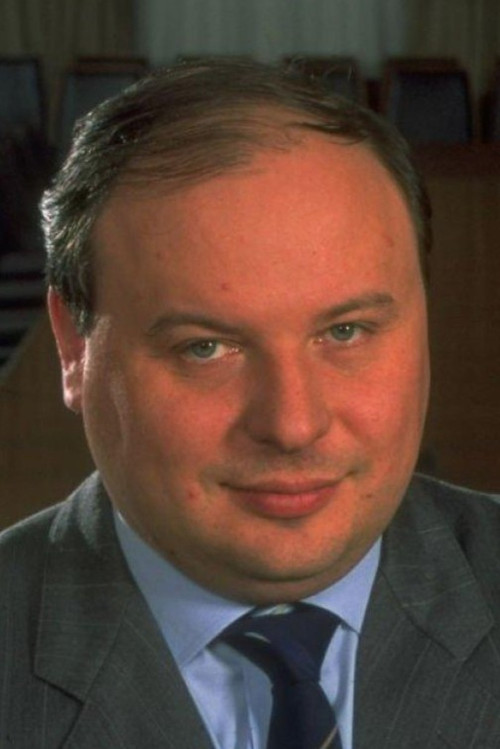
Yegor Timurovich Gaidar (/jɪˈɡɔːr ɡaɪˈdɑːr/; Russian: Егор Тимурович Гайдар, IPA: [jɪˈɡor tʲɪˈmurəvʲɪtɕ ɡɐjˈdar]; 19 March 1956 – 16 December 2009) was a Soviet and Russian economist, politician, and author, who was the acting Prime Minister of Russia in 1992 and simultaneously held several other cabinet roles. Gaidar was also in the State Duma from 1993 to 1996 and from 1999 to 2003 as a member of Democratic Choice of Russia and the Union of Right Forces. Gaidar was the son of a Soviet naval officer and graduated from Moscow State University. He worked in economic research institutes before joining a commission that advised Soviet President Mikhail Gorbachev in the 1980s. Following the dissolution of the Soviet Union, Gaidar was the chief architect of Russia's controversial shock therapy reforms, which brought him both praise and harsh criticism. He entered the cabinet led by President Boris Yeltsin as Minister of Finance, Minister of Economy, and Deputy Prime Minister for Economic Policy, serving from 1991 to 1992. He was also the First Deputy Prime Minister of Russia in 1992, with Yeltsin and later himself as acting prime minister, and again from 1993 to 1994, in Viktor Chernomyrdin's cabinet, where he was also the acting Minister of Economy. Gaidar became widely unpopular for his reforms to transition Russia to a market economy, during which the country experienced hyperinflation and mass impoverishment, and the parliament pressured Yeltsin to remove him. He left the government in early 1994, when the administration decided to take a more gradual approach to economic reform. Many Russians held him responsible for the economic hardships that plagued the Russian Federation in the 1990s, although liberals praised him as a man who did what had to be done to save the country from complete collapse. Gaidar founded the party Democratic Choice of Russia, and as a member of that party was elected to the State Duma in the 1993 legislative election. He stopped supporting Boris Yeltsin due to the First Chechen War. Democratic Choice of Russia failed to win any seats in the 1995 election, but Gaidar returned to the Duma in the 1999 election when his party joined the Union of Right Forces electoral bloc. He was an advisor to Mikhail Kasyanov, the prime minister in the early administration of President Vladimir Putin. After the electoral bloc failed to keep its seats in the 2003 election, Gaidar left politics and returned to academic work, though he was still consulted for economic advice. He went on to publish several books on economics. Gaidar died of pulmonary edema provoked by myocardial ischemia in 2009.
Movie credits linked with Yegor Gaidar.
Series credits linked with Yegor Gaidar.