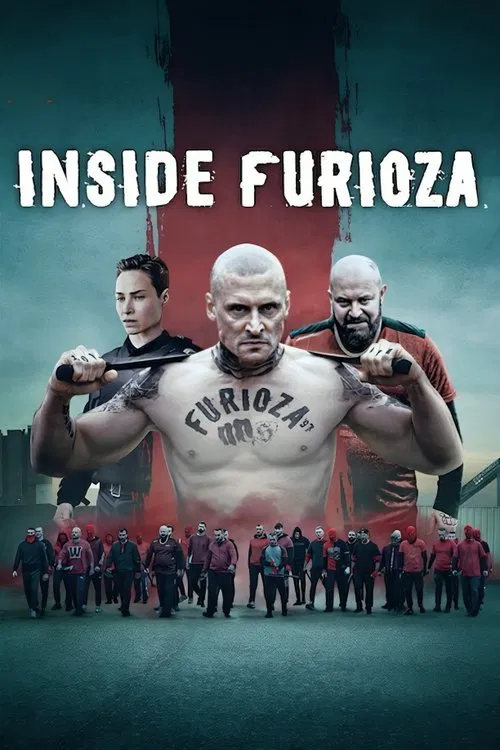
The Hollow Crown of ConcreteIf *Furioza* (2021) was a shout—a raw, visceral howl of tribal loyalty and street-level brutality—its sequel, *Inside Furioza* (2025), is the long, agonizing echo that follows, proving that the silence after the violence is often more deafening than the fight itself. Director Cyprian T. Olencki returns to the bleak, desaturated world of Polish hooliganism, but he has wisely abandoned the "undercover cop" tropes of the first film to focus on a far more corrosive subject: the rotting soul of a man who finally gets everything he wanted.

The narrative pivot here is bold. We leave behind the sympathetic doctor-protagonist of the original to lock step with Golden (a terrifyingly committed Mateusz Damięcki), the shaved-headed, scar-tissue-laden enforcer whose ambition has always outpaced his humanity. Following the murder of the gang’s former leader, Kaszub, Golden seizes the crown of the Furioza firm. But Olencki is not interested in glorifying this rise. Through a visual language that feels increasingly claustrophobic—tight frames, gray-washed Dublin docks, and the sterile coldness of drug warehouses—the director illustrates that Golden’s "empire" is little more than a prison of his own making. The camera no longer shakes with the kinetic energy of a stadium brawl; instead, it lingers on Damięcki’s face, catching the micro-expressions of a man realizing that heavy lies the head that wears the balaclava.
The film’s aesthetic transformation mirrors its protagonist’s descent. Where the first film felt like a documentary of street war, *Inside Furioza* operates as a psychological gangster tragedy, closer in spirit to a Polish *Scarface* or a modern Macbeth. The shift from local stadium rivalries to cross-border drug trafficking in Ireland strips away the romantic myth of the "football fan." We are no longer watching warriors defending their turf; we are watching middle-managers of violence arguing over logistics. One particularly haunting sequence involves a confrontation at a container port—stripped of the tribal colors and chanting that usually give these men their identity, they look small, cold, and profoundly lost against the massive, indifferent machinery of international trade.

At the center of this storm is Damięcki. It is a performance of reptilian intensity. He plays Golden not as a triumphant kingpin, but as a man vibrating with an anxiety he can't articulate. His interactions with "Antman" (Szymon Bobrowski) and the returning police pressure create a triangle of doom that feels inevitable. The script strips Golden of his excuses; without the "cause" of the club, his violence is revealed as mere pathology. The tragedy isn't that he fails; it's that he succeeds, and finds the view from the top is just as gray and empty as the gutters he crawled out of.

*Inside Furioza* is not an easy watch. It lacks the adrenaline-fueled catharsis of its predecessor, replacing it with a slow-burn dread that asks what happens when the war is won but the warrior cannot go home. It is a grim, uncompromising deconstruction of toxic masculinity that suggests the only thing more dangerous than a hooligan without a cause is a hooligan with a business plan. Olencki has crafted a sequel that doesn't just continue the story, but matures it, leaving us with a chilling portrait of power as a terminal illness.