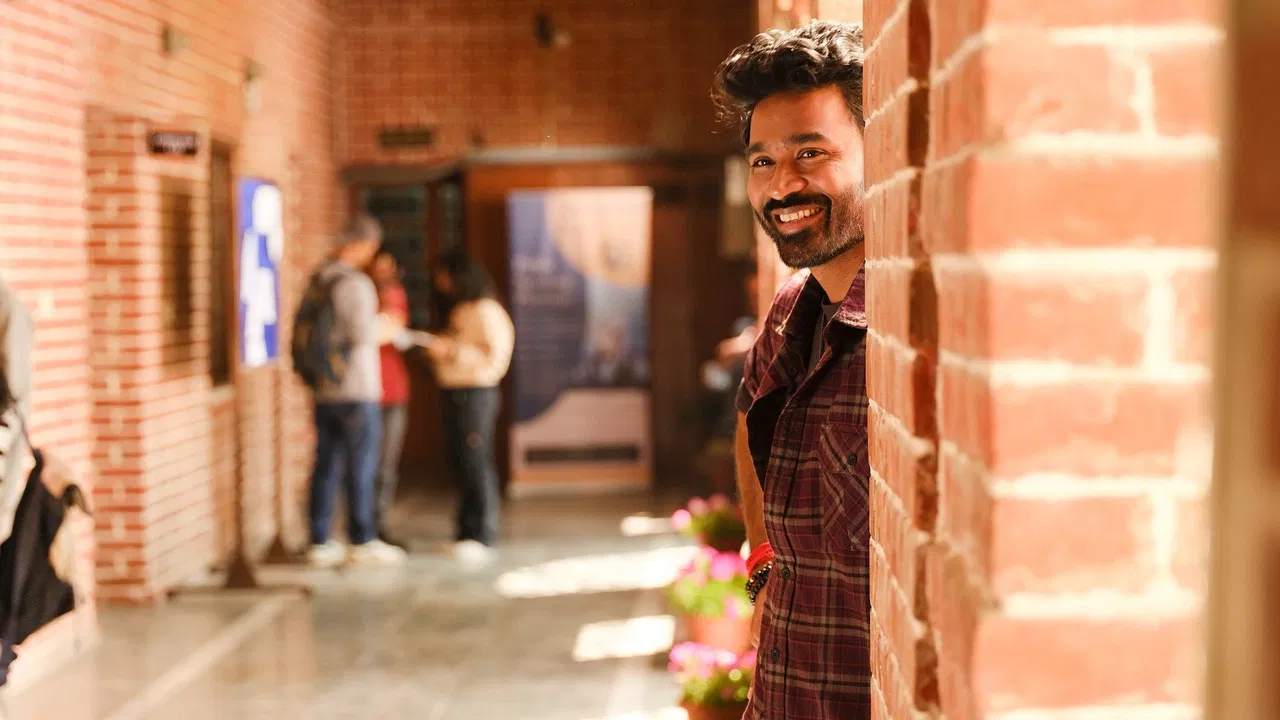
Love in the Time of AttritionCinema has long possessed a fascination with the self-destructive lover—the man whose affection is a weapon, aimed as much at himself as at the object of his desire. Director Aanand L. Rai built his career on the textural richness of small-town India and the messy, often uncomfortable dynamics of such affection. In *Tere Ishk Mein* (2025), billed as a spiritual successor to his polarizing yet beloved *Raanjhanaa*, Rai attempts to resurrect the ghost of Kundan, the tragic protagonist of his 2013 hit. However, where *Raanjhanaa* operated with a certain chaotic innocence that softened its sharper edges, *Tere Ishk Mein* feels like a darker, more jagged beast, struggling to justify its own rage.
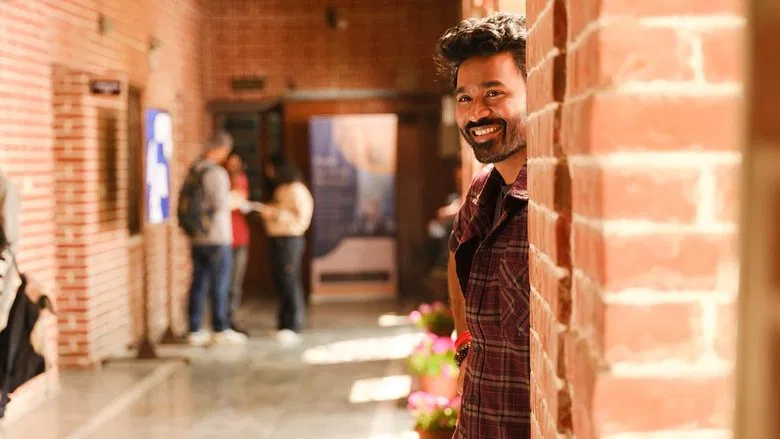
From a visual standpoint, the film is a masterclass in atmospheric dichotomy. Cinematographer Tushar Kanti Ray captures the suffocating dust and heat of Varanasi with a tactile intimacy that makes the viewer feel the sweat on Shankar’s (Dhanush) brow. The camera lingers on the crumbling architecture and narrow alleyways, framing them not as quaint backdrops, but as cages that trap the protagonist in his socio-economic reality. This grittiness is starkly contrasted later in the film by the sterile, disciplined blues and greys of the Indian Air Force sequences. Yet, this visual shift feels less like a progression and more like a fracture; the film’s aesthetic identity splits, mirroring a narrative that cannot quite decide if it wants to be a gritty character study or a patriotic spectacle.

At the narrative's center is the volatile relationship between Shankar and Mukti (Kriti Sanon). The premise—a psychology student studying a volatile subject who essentially becomes her "project"—is fraught with ethical and emotional landmines. Sanon navigates this with a commendable stoicism, trying to find the human beneath the specimen, but the script often reduces her to a reactive force, a mirror for Shankar's outbursts. Dhanush, an actor of immense physical capability, throws his entire being into Shankar. He vibrates with a kinetic, nervous energy that is mesmerizing to watch, yet the character lacks the redemptive charm that might make his toxicity palatable. The film conflates persistence with affection in a way that feels increasingly anachronistic. We are asked to sympathize with a love that functions more like a siege, forcing us to question where the line between passion and pathology truly lies.

The film’s ultimate undoing is its ambition to be too many things at once. By pivoting from a localized romance to a high-stakes military drama, the story loses its emotional footing. The transition is meant to signify Shankar’s maturation—channeling his destructive energy into service—but it plays out as a disjointed subplot that distracts from the core conflict. A.R. Rahman’s score works overtime to stitch these disparate halves together, providing a sonic majesty that the screenplay rarely earns.
In the end, *Tere Ishk Mein* is a film that screams for attention but offers little in the way of new insight. It is an echo chamber of passion, repeating the beats of its predecessor without evolving the conversation. Rai proves he can still frame a beautiful shot and extract raw performances, but the film serves as a reminder that intense emotion, without narrative discipline or moral evolution, is just noise.