✦ AI-generated review
The Gloss of Trauma
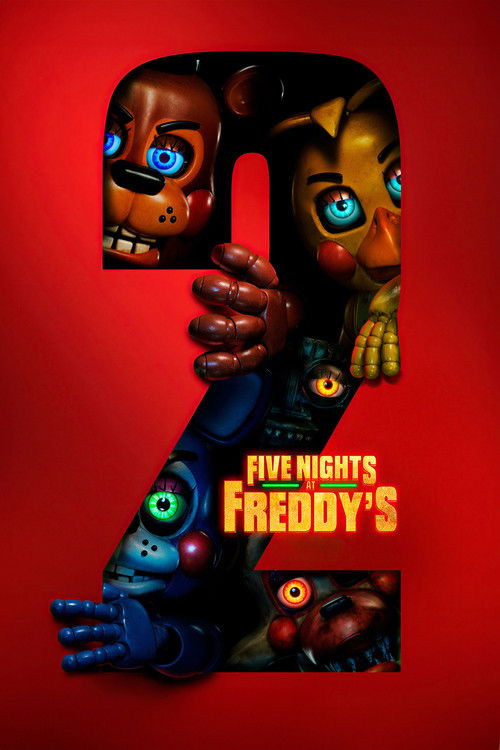
If the first *Five Nights at Freddy’s* film was a somber, albeit uneven, meditation on grief disguised as a mascot horror, its sequel, *Five Nights at Freddy’s 2*, is a frantic, neon-soaked interrogation of how we process tragedy. Directed again by Emma Tammi, this 2025 follow-up abandons the dusty, claustrophobic intimacy of the original for something louder, shinier, and significantly more cynical about the nature of spectacle. It is a film that asks an uncomfortable question: how long does it take for a massacre to become merchandise?
The narrative picks up one year after the events of the first film, but the atmosphere has shifted drastically. The supernatural nightmare at Freddy Fazbear’s Pizza has not been buried; it has been commodified. The town has birthed "Fazfest," a campy local festival that turns the rumors of missing children and possessed animatronics into tourist bait. This is Tammi’s sharpest directorial stroke: presenting the horror not just as a physical threat, but as a cultural product. The visual language shifts from the rust and rot of the 1980s to the garish, plastic sheen of the "Toy" animatronics—pristine, rosy-cheeked facsimiles that feel infinitely more soulless than their withered predecessors.
Tammi, whose background in atmospheric horror (*The Wind*) was stifled by the mechanical demands of the first film, finds deeper footing here. She juxtaposes the chaotic, candy-colored hysteria of the festival with the suffocating silence of the pizzeria’s bowels. The "Toy" animatronics are framed not merely as robots, but as idols of forced happiness. When the camera lingers on the polished porcelain face of Toy Chica or the frozen grin of Toy Freddy, the effect is less about a jump scare and more about the uncanny valley of manufactured joy. The film suggests that the only thing scarier than a ghost is a ghost packaged for mass consumption.
At the emotional center remains the fractured Schmidt family. Josh Hutcherson’s Mike is still carrying the weight of the past, but the film’s heart beats in Piper Rubio’s Abby. Her desire to "reconnect" with the animatronics—viewing these lethal vessels as friends—is a heartbreaking metaphor for how children normalize their trauma. The script, while occasionally buckling under the weight of its own mythological density, allows these characters to breathe. The horror here isn't just that the robots are alive; it’s that the humans are desperate to find connection in a place designed to consume them.
The arrival of the "long-forgotten horror" and the deeper dive into the lore feels less like a checklist for the initiated and more like a descent into a specific kind of madness. Matthew Lillard’s presence, though rationed, looms over the film like a sickness, a reminder that underneath the fresh paint and the festival lights, the rot remains.
*Five Nights at Freddy’s 2* is a darker, more confident beast than its predecessor. It trades the first film’s tentative steps for a sprint into the absurd, yet it manages to keep its humanity intact. It is a film about the ghosts we refuse to banish because we are too busy selling tickets to see them. In polishing the surface, Tammi has revealed the ugliness underneath, proving that sometimes, a sequel can be more than an echo—it can be a reflection.