The Architecture of SuffocationThe Danube Delta is often framed as a sanctuary of biodiversity, a place where the waters of Europe bleed into the Black Sea in a sprawling network of reeds and silence. In Emanuel Pârvu’s *Three Kilometres to the End of the World*, this geography is not a refuge but a cage. Following the rigorous, scalpel-sharp tradition of the Romanian New Wave—a cinematic lineage defined by Cristian Mungiu and Cristi Puiu—Pârvu constructs a moral procedural that feels less like a drama and more like a slow-motion asphyxiation. This is a film about the terrifying efficiency with which a community will amputate one of its own limbs to save the infected body of the "status quo."

The narrative catalyst is brutal in its simplicity. Adi (Ciprian Chiujdea), a quiet 17-year-old spending the summer in his home village, is beaten on the street one night. When he stumbles home, bruised and broken, the initial parental instinct is protection. His father (Bogdan Dumitrache) demands justice; his mother (Laura Vasiliu) offers care. However, the moment the motive for the attack is revealed—Adi was seen kissing a male tourist—the film’s temperature drops to absolute zero. The "crime" is no longer the assault on the boy’s body, but the "shame" he has brought upon the village.
Pârvu’s visual language is deceptive. He shoots the Delta in wide, static frames that capture the golden light and the swaying flora, creating a paradise that contrasts violently with the ugliness of the human interactions. The camera often lingers at a distance, observing conversations between the police chief and the father with a detached, clinical gaze. This distance is essential; it mimics the way the village institutions operate. There is no screaming, no chaotic editing. Instead, the destruction of a young man’s life is negotiated in hushed tones, through favors, debts, and the bureaucratic language of "keeping the peace."
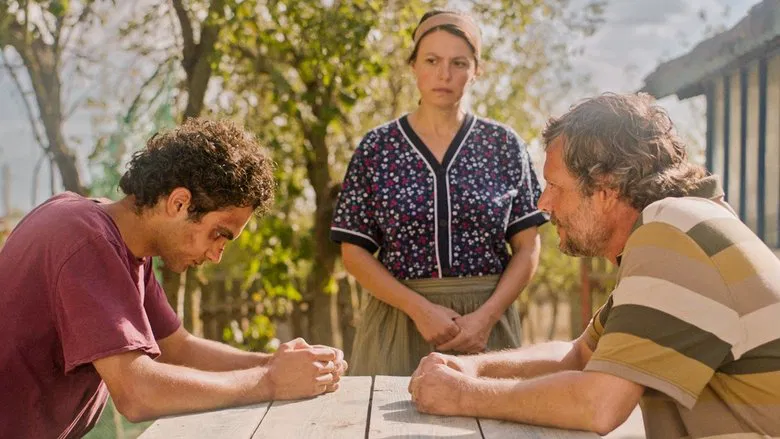
The film’s most harrowing sequence is not the initial beating, but the "solution" the parents seek. In a moment of horrifying betrayal, they turn to the local priest. The ensuing scene, which functions as a form of social exorcism, is terrifying specifically because it is devoid of supernatural theatrics. It is a dry, ritualistic abuse of power, where scripture is weaponized to gaslight a child into believing his existence is a sickness. Here, Pârvu dissects the concept of "conditional love." The parents do not act out of malice, but out of a warped sense of salvation; they are destroying their son to "save" him, a paradox that anchors the film’s emotional tragedy.
Some critics have noted that Adi himself is a largely silent protagonist, a passive object in his own story. Yet, this silence is the film’s loudest scream. Adi is not given a voice because, in this world, he does not possess one. He is talked about, negotiated over, and prayed at, but rarely listened to. His passivity is a reflection of his powerlessness against a triumvirate of oppression: the Church, the State (police), and the Family.

*Three Kilometres to the End of the World* is a difficult, bruising watch, culminating in an ending that suggests the only cure for this specific sickness is amputation—the severing of ties. By the time the credits roll, Pârvu has successfully dismantled the romantic myth of the "tight-knit community," revealing that when a village is too tight, it doesn't just hold you; it crushes you. This is a vital, furious entry into queer cinema, arguing that sometimes, paradise is just a prison with a better view.