✦ AI-generated review
The Whiteout of Memory
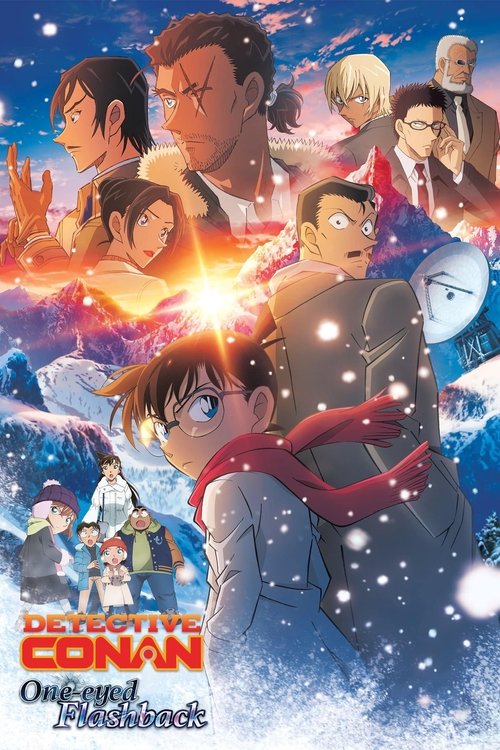
There is a particular kind of silence that exists only in snow. It is a dampening, suffocating quiet that swallows sound and, if one is not careful, history itself. In *Detective Conan: One-Eyed Flashback* (2025), director Katsuya Shigehara understands this silence intimately. Marking the twenty-eighth cinematic entry in a franchise that often risks becoming a carousel of explosions and fan-service cameos, Shigehara’s feature debut is a striking pivot toward the elemental. It strips away the metropolitan gloss of Tokyo for the biting cold of the Nagano mountains, delivering a film that feels less like a shonen adventure and more like a hard-boiled Nordic noir.
The film’s central conceit—a cold case thawing in the present—is standard procedural fare, but the execution is refreshingly tactile. We are reintroduced to Inspector Kansuke Yamato, a character whose very design (one eye, a scarred face, a crutch) has always suggested a story too violent for the main series’ usual brightness. Here, he is the anchor. The narrative hinges on his trauma: a botched pursuit in the snow ten months prior that cost him his eye and nearly his life. Shigehara films these flashback sequences not as clear expository scenes, but as fragmented, chaotic blurs of white and grey, mimicking the confusion of a mind trying to reconstruct a moment of impact. The visual language of the film is dominated by this "snow blindness"—the screen frequently washes out, forcing the audience, like Yamato, to squint through the glare to find the truth.
Crucially, the film moves the franchise's lens away from the indestructible superman tropes often associated with its later films. While Conan Edogawa is present, the emotional weight is carried by the "Nagano Trio"—Yamato, Yui Uehara, and Taka’aki Morofushi. Their dynamic is adult, weary, and steeped in a professionalism that barely masks deep personal loyalty. One specific scene stands out: the moment the massive parabolic antenna at the Nobeyama Radio Observatory begins to rotate. The mechanical groan of the machinery triggers a psychosomatic pain in Yamato’s missing eye. It is a masterful sequence of sound design; the grinding metal becomes indistinguishable from the roar of the avalanche in Yamato’s memory. It transforms a piece of high-tech infrastructure into a haunted object, suggesting that technology can record the stars, but it cannot decode the scars of the human heart.
The script, penned by veteran Takeharu Sakurai, wisely gives Kogoro Mouri a subplot that feels earned rather than buffoonish. By connecting him to a former colleague ("Wani") and a past investigation, the film reminds us that before he was the "Sleeping Kogoro," he was a capable officer. This respectful treatment of the adult cast elevates the material, allowing the film to explore themes of regret and professional duty without cynicism.
*One-Eyed Flashback* is not without its indulgences—the climax inevitably escalates into the bombastic action set pieces the box office demands. Yet, the film’s soul remains in its quieter, colder moments. It posits that while the snow may cover the blood, it preserves it rather than washing it away. Shigehara has crafted a film that argues the past is not a foreign country, but a shadow in our peripheral vision, always waiting for the moment we blink. In a series nearing its third decade, this wintry, wounded entry proves that *Detective Conan* can still surprise us, provided it is willing to venture out into the cold.