The Sunshine Noir of the American SoulTo revisit *Dexter* in 2006 is to witness the birth of a specific kind of television alchemy—a moment when the anti-hero, previously a figure of gritty mob dramas, was dragged out of the shadows and into the blinding Florida sun. While Tony Soprano operated in the dim backrooms of New Jersey, Dexter Morgan (Michael C. Hall) hid in plain sight, bathed in the saturated pastels of Miami. This wasn't just a crime procedural; it was a subversion of the American dream, suggesting that the monster under the bed had grown up, got a job in forensics, and brought donuts for the office.
The brilliance of the show's pilot and inaugural season lies in its visual language, which creates a suffocating sense of irony. Directors and cinematographers on the series utilized a "sunshine noir" aesthetic—bright teals, hot pinks, and overexposed whites—to contrast the macabre nature of Dexter's moonlighting gig.

This visual dissonance is nowhere more apparent than in the opening title sequence, a masterpiece of macro photography that renders a morning routine—shaving, frying ham, flossing—into a visceral montage of violence. It tells us everything we need to know before a single line of dialogue is spoken: to this man, the mundane is violent, and violence is mundane.
At the center of this candy-colored nightmare is Michael C. Hall’s mesmerizing performance. Hall plays Dexter not as a man pretending to be a monster, but as a monster desperately studying how to be a man. His internal monologue—a device that often feels lazy in lesser hands—is essential here. It provides a dry, anthropological commentary on human behavior, turning the audience into co-conspirators. We are the only ones who know the truth, forcing us into an uncomfortable intimacy with a psychopath. When he navigates his relationship with his foul-mouthed, emotionally fragile sister Debra (Jennifer Carpenter) or his damaged girlfriend Rita, we see the "mask of sanity" slip and slide, revealing the terrified, empty thing beneath.
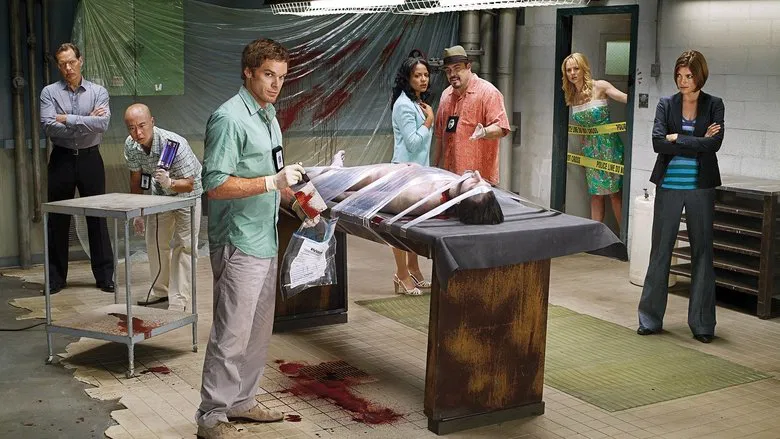
The first season’s narrative arc, centered on the "Ice Truck Killer," serves as a perfect mirror for the protagonist. While Dexter follows the "Code of Harry"—a set of ethical guardrails instilled by his father to channel his urges toward other killers—the Ice Truck Killer represents the id unleashed, a chaotic force that taunts Dexter with the possibility of being truly known. This cat-and-mouse game is not just a police hunt; it is a battle for Dexter's soul. The climax of the season forces a choice between his constructed family (Debra) and his biological truth, a decision that ripples through the entire series.

Ultimately, *Dexter* asks a question that remains uncomfortable decades later: Why do we root for the butcher? Perhaps it’s because in a chaotic world, Dexter offers a fantasy of control. He is a cleaner. He imposes order on the messy, inefficient justice system. But as the seasons wear on, the show (at its best) deconstructs this fantasy, revealing that violence, no matter how "righteous," is a cancer that eats away at everything it touches. In 2006, *Dexter* didn't just give us a serial killer to love; it handed us a mirror and asked us why we were smiling.