The Moral Murk of the DeepThe aquatic horror genre has spent fifty years swimming in the wake of Steven Spielberg’s *Jaws*, a film that terrified the world by turning the ocean into a realm of indiscriminate, primal hunger. But in 2026, the cultural current has shifted. We no longer look at apex predators with simple fear; we view them with guilt. Jo-Anne Brechin’s *Killer Whale* attempts to navigate this choppy moral channel, presenting us with a creature feature that wants to be both a blood-soaked survival thriller and a sombre post-*Blackfish* parable. It is a film at war with itself, torn between the impulse to thrill the audience and the need to lecture them.
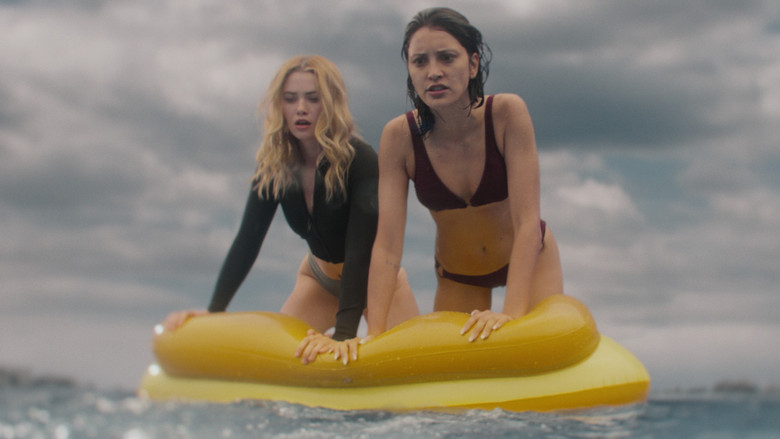
Visually, Brechin—whose background lies largely in the polished world of romantic dramedies—brings a jarringly sun-drenched aesthetic to the horror. The cinematography eschews the murky, claustrophobic greys typical of the genre for a palette of aggressive turquoise and blinding white. On paper, this contrast should work; the terror of the open water is often that there is nowhere to hide in plain sight. However, this brightness often serves only to highlight the film's technical limitations. The digital rendering of Ceto, the vengeful orca, frequently breaks the immersion, rendering the antagonist weightless just when she needs to feel like a leviathan of flesh and rage. When the visual reality dissolves, we are left staring not at a monster, but at a pixelated idea of one.
The narrative anchors itself to Maddie (Virginia Gardner), a young woman defined—perhaps too rigidly—by a "tragic backstory" involving the loss of her boyfriend and her hearing. The film constructs a heavy-handed parallel between Maddie’s silent, internal trauma and Ceto’s psychological scars from years of captivity. Gardner, a capable performer who has navigated the survival genre before in *Fall*, does her best to ground Maddie’s terror in something human. There are moments, particularly when she attempts to communicate with the whale using the frequencies of her hearing aid, where the film grazes against a profound idea: that suffering is a universal language across species.
However, *Killer Whale* capsizes under the weight of its own mixed messaging. By establishing Ceto as a victim of human cruelty—a sentient being driven mad by solitary confinement and grief—the script robs the audience of the guilt-free catharsis required for a creature feature. We are asked to fear the beast while simultaneously rooting for her liberation, creating a dissonance that drains the tension from the set-pieces. When the violence erupts, it feels neither tragic enough to be a drama nor fun enough to be a B-movie.
Ultimately, *Killer Whale* is a artifact of a cinema culture trying to have it both ways. It wants the jump scares of a monster movie without the moral baggage of demonizing nature. But nature, as cinema has taught us, is indifferent to our moralizing. By trying to humanize the hurricane, Brechin inadvertently tames it, leaving us with a thriller that, much like its captive subject, feels tragically contained.