The Analog Soul in a Digital CageThere is a specific, melancholic texture to the late-career renaissance of Jackie Chan. For years, audiences watched him age in real-time, often wincing as he attempted to recapture the kinetic frenzy of *Police Story* in films that felt increasingly synthetic. However, with *The Shadow’s Edge* (2025), director Larry Yang—who previously collaborated with Chan on the nostalgic *Ride On*—finally stops trying to reverse the clock. Instead, he leans into the weight of time. This is not just an action movie; it is a meditation on obsolescence, pitting the tactile intuition of the past against the cold, algorithmic certainty of the present.

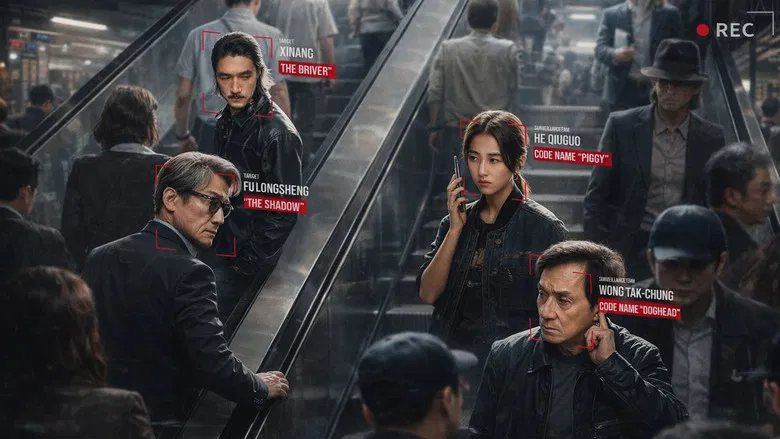
Technically, *The Shadow’s Edge* acts as a reimagining of Yau Nai-hoi’s 2007 classic *Eye in the Sky*, but Yang transplants the narrative from the gritty streets of Hong Kong to the neon-glossed, surveillance-heavy landscape of Macau. The visual language reflects this shift immediately. The film opens with a suffocating reliance on "Sky Eye" technology and AI tracking systems—a digital panopticon that feels sterile and overwhelming. Yet, when the technology fails to catch a phantom-like crew of crypto-thieves, the film visually exhales, slowing down to match the pace of Wong Tak-chong (Chan). Yang frames Chan not as a superhero, but as a craftsman. The camera lingers on his eyes, not his fists, emphasizing the art of *looking* over the act of fighting.
The film’s central conflict is embodied by its two titans: Chan’s analog detective and Tony Leung Ka-fai’s "Wolf King" Fu Lung-sang. Leung, reprising a variation of his role from the 2007 original, brings a terrifying, reptilian stillness to the screen. If Chan is the warm, beating heart of the old guard, Leung is its ruthless shadow. Their dynamic is less about physical combat and more about a clash of philosophies. One of the film’s most widely discussed sequences—the "market tracking" scene—illustrates this perfectly. As Wong teaches his young apprentice (Zhang Zifeng) to blend into the chaotic rhythm of a wet market, the film abandons the slick, drone-shot aesthetic of the opening for handheld, ground-level intimacy. It’s a masterclass in tension that relies on glances and reflections rather than explosions.
However, the film is not without its stumbling blocks. Yang has a tendency toward melodrama that sometimes undercuts the noir atmosphere. The subplot involving Zhang Zifeng’s character—the daughter of Wong’s former partner—drifts dangerously close to cliché, occasionally feeling like a forced emotional tether in a story that didn’t need it. The script struggles to balance the "found family" dynamic of the police unit with the brutal efficiency of Leung’s criminal adopted sons. Yet, when the film focuses on the silent, psychological chess match between the two leads, it soars. The "dinner scene," where the two adversaries share a meal unaware (or perhaps fully aware) of each other’s identity, is played with a quiet intensity that outshines any car chase.
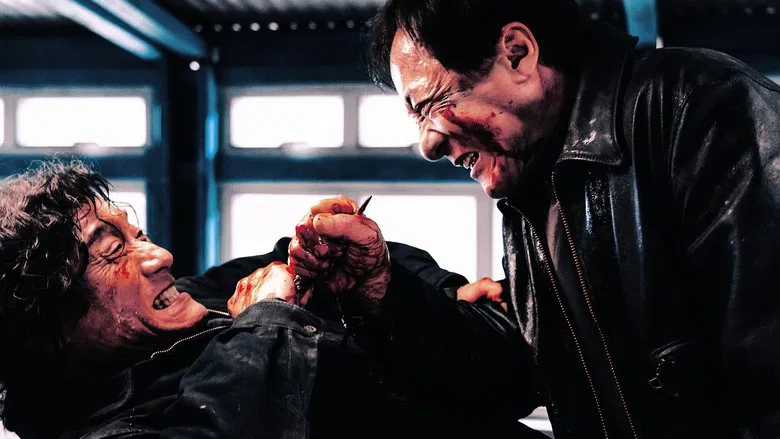
Ultimately, *The Shadow’s Edge* succeeds because it allows its star to be human. It acknowledges that the era of the indestructible super-cop is over, replaced by a world of data streams and facial recognition. But in doing so, it argues that there is no algorithm for human instinct. While it may not rewrite the genre, it offers a dignified, gripping chapter in the legacy of a legend who has finally stopped running from his age and started using it as his weapon.