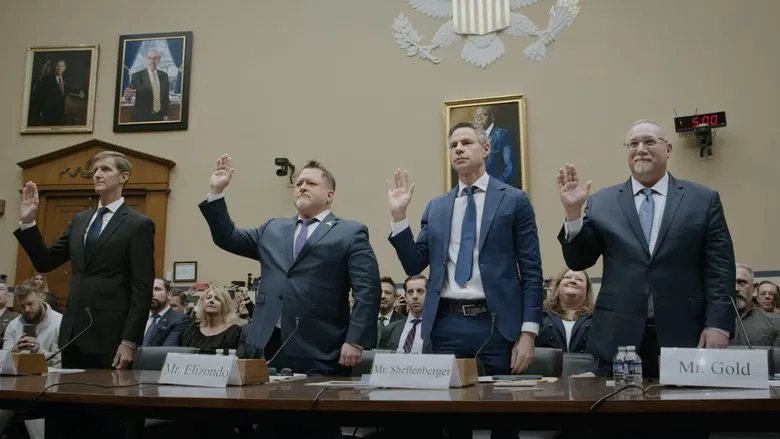
The Silent Scream of BureaucracyIf there is a defining anxiety of the mid-2020s, it is not the fear of the unknown, but the suspicion that the known is being kept from us by men in beige rooms. *The Age of Disclosure*, the directorial debut from producer Dan Farah (*Ready Player One*), taps directly into this vein of modern paranoia. It is a documentary that eschews the grainy, shaky-cam aesthetic of its predecessors for the polished, almost sterile visual language of a congressional hearing. Farah understands that to legitimize the illegitimate, one must dress it up in a suit and tie.
Farah’s approach is notably restrained. Where lesser filmmakers might drown the audience in ominous synthesizer swells or dramatic reenactments of greys peering through bedroom windows, Farah offers a procession of credentials. The film’s visual landscape is dominated not by starfields, but by the imposing architecture of Washington D.C.—the brutalist concrete of the Pentagon and the marble echoes of the Capitol. These structures loom over the narrative, serving as silent antagonists in a story about the fluidity of truth.

The "conversation" surrounding *The Age of Disclosure* has been less about the existence of aliens and more about the credibility of the messengers. By assembling 34 senior officials—including Senator Marco Rubio and former intelligence officer Luis Elizondo—Farah attempts to bludgeon the viewer with authority. The film argues that the "tinfoil hat" era is dead, replaced by a terrifying bureaucratic reality: a secret cold war to reverse-engineer non-human technology. This is not a film about wonder; it is a film about weaponry and geopolitics. The central discourse here is one of somber vindication for the "UAP" (Unidentified Anomalous Phenomena) movement, yet it carries a heavy, almost exhausted tone. The excitement of discovery is dampened by the weight of an 80-year lie.
Visually, the film relies heavily on the "talking head" format, but Farah elevates it through lighting and composition. The interviewees are often framed in sharp relief against darkness or blurred, high-tech backgrounds, isolating them as sole bearers of a dangerous flame. A key sequence involves a breakdown of the "legacy programs"—secretive projects hidden within special access programs. Farah utilizes intricate, almost clinical graphics to map out this labyrinth of secrecy. It is effective, creating a suffocating sense of a shadow government that operates with impunity. The horror here is not the alien, but the human capacity for compartmentalization.

However, the film’s "heart"—if one can call it that—struggles to beat beneath the armor of its own seriousness. Luis Elizondo serves as the narrator and emotional anchor, a man who carries the weary demeanor of a whistleblower who has seen too much and said too little. We watch him navigate the skepticism of the public and the hostility of his former employers. Yet, the film remains emotionally distant. It treats these revelations as data points rather than spiritual upheavals. We are told that humanity is not alone, that our place in the universe is smaller than we imagined, but the film seems more interested in the security clearances of the people telling us this than the profound existential shock of the information itself.
Ultimately, *The Age of Disclosure* is a necessary artifact of our time. It captures the moment when the fringe moved to the center, when the conspiracy theory was read into the congressional record. It is a cold, hard look at a subject that has been feverishly romanticized for decades. Farah has not made a film to inspire us to look up at the stars with hope; he has made a film that demands we look at our leaders with suspicion. It is a successful prosecution of the case for disclosure, but one leaves the theater feeling not enlightened, but deeply, unsettlingly managed.
 Verdict:
 A chilling, meticulously constructed procedural that trades the wonder of the cosmos for the terror of the filing cabinet. It validates the believer but may leave the dreamer cold.