The Mirror Crack’d: Identity in the Age of Algorithmic EnvyIf the first film, *Influencer* (2022), was a warning shot across the bow of the travel-vlog generation, Kurtis David Harder’s 2025 sequel, *Influencers*, is a full-scale demolition of the vessel. We have moved past the initial shock of the “perfect life” being a lie and settled into a far more uncomfortable reality: we know it’s a lie, yet we demand the performance anyway. In this chilling, sun-drenched noir, Harder suggests that the only thing more dangerous than a wolf in sheep’s clothing is a wolf who realizes the sheep are desperate to be eaten.

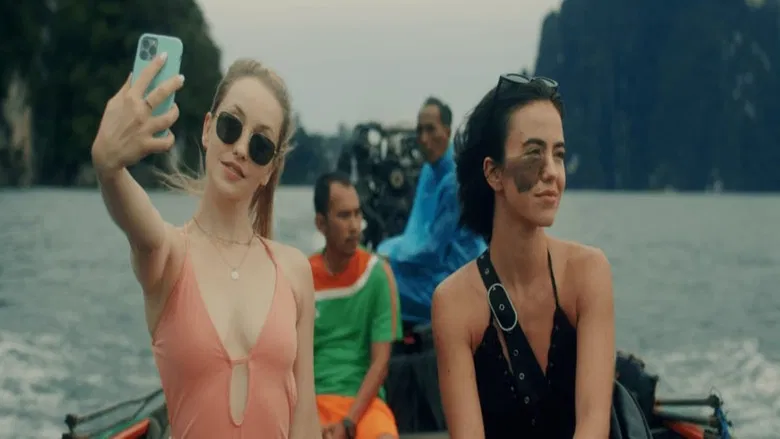
The film picks up with the enigmatic, lethal grifter CW (the magnetic Cassandra Naud) attempting to play house in the south of France. Having escaped the blood-soaked beaches of Thailand, she is now weaponizing domesticity, trying to forge a “real” life with her girlfriend, Diane. Harder’s visual language has evolved alongside his antagonist. Where the first film relied on the glossy, over-saturated aesthetic of a travel reel to critique it, *Influencers* adopts a more claustrophobic elegance. The cinematography frames the French Riviera not as an open paradise, but as a gilded cage of infinity pools and gated villas. The camera often lingers on Naud’s face—specifically the birthmark that she refuses to digitally erase—using it as a defiant anchor of reality in a world dissolving into deepfakes and AI voice cloning.
The narrative engine revs when Charlotte (Georgina Campbell), a vacuous lifestyle guru, encroaches on CW’s carefully curated anonymity. The resulting conflict is not just about survival; it is a war of philosophies. Harder brilliantly juxtaposes Charlotte’s desperate, loud need for validation against CW’s silent, predatory confidence. The tension peaks in a scene at a secluded cliffside landmark. It isn’t the violence that chills, but the preamble—the way CW watches Charlotte stage a selfie, dissecting the artificiality with the cold precision of a surgeon. The scene is a masterclass in visual storytelling, stripping away the glamour to reveal the pathetic, lonely mechanics of "content creation."

However, the film’s true heart of darkness lies in the return of Madison (Emily Tennant), the survivor of the first film. Here, Harder takes a risk that pays off dividends. Madison is not the typical "final girl" seeking justice; she is trauma-bonded to her abuser, obsessed with the woman who nearly destroyed her. This dynamic elevates the film from a standard slasher to a complex psychological study. The interplay between Madison and CW suggests that in the digital age, hatred is just another form of engagement. They are trapped in a feedback loop, two distorted reflections unable to look away from one another.
The climax, which shifts the action to a chaotic confrontation involving a misogynistic streamer in Bali, risks overstuffing the narrative, but it lands its thematic punch. By introducing live-streaming into the murder, Harder forces the audience to become complicit. We are no longer just watching a movie; we are the "viewers" scrolling past the carnage, perhaps pausing to leave a comment.
*Influencers* is a cruel, beautiful, and necessary film. It lacks the surprise factor of its predecessor but replaces it with a deepening cynicism that feels entirely appropriate for 2025. It argues that identity is no longer something we possess, but something we rent, steal, or kill for. In the end, CW isn’t just a villain; she is the ultimate influencer—because she understands that in a world of screens, the only power that matters is the power to edit the feed.