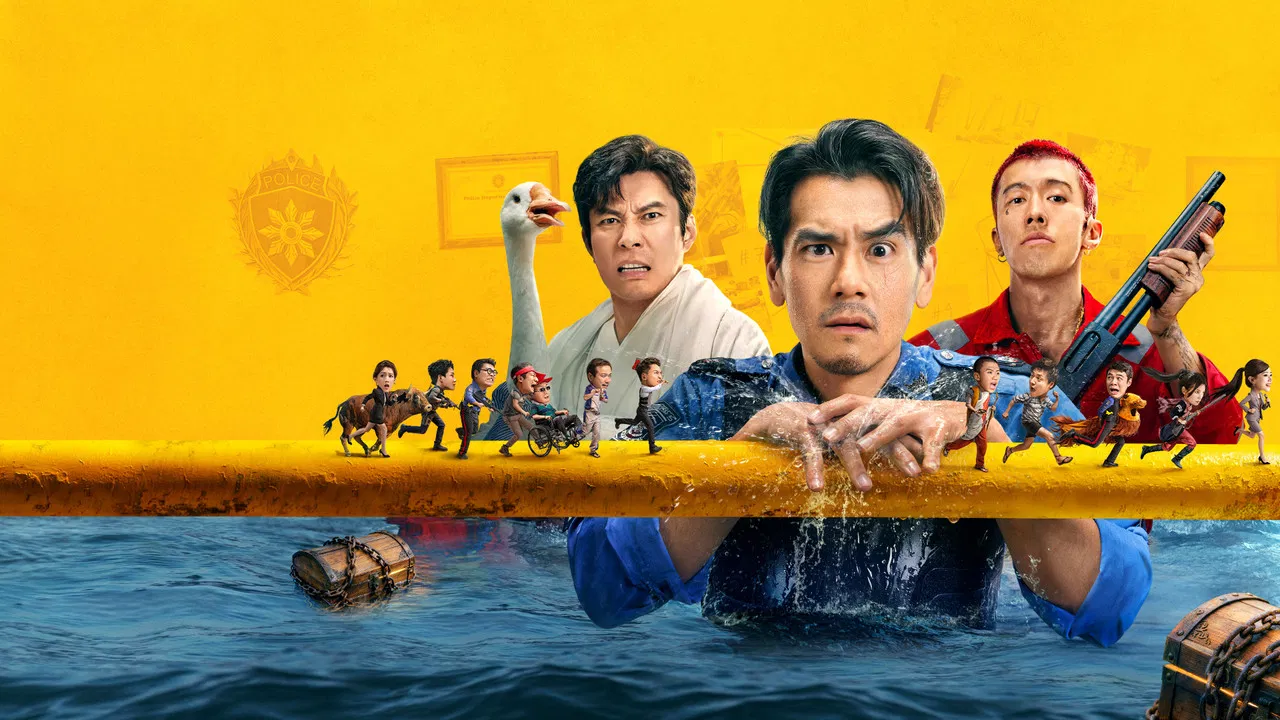
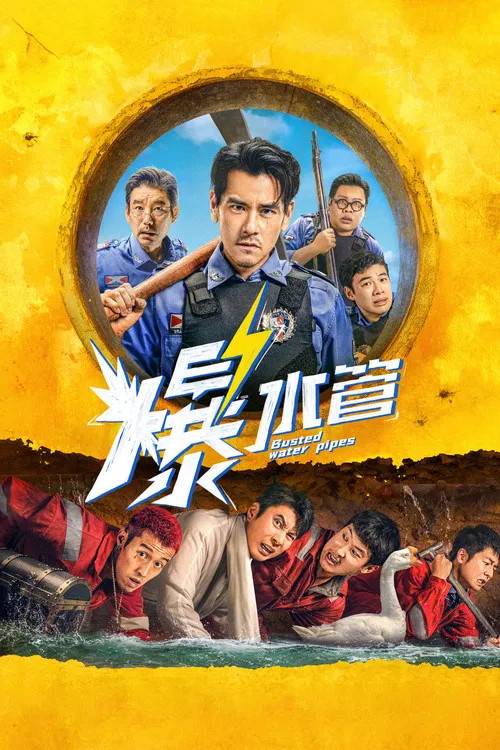
The Paradox of PerfectionIn the modern cinematic landscape, the "cop movie" usually oscillates between two poles: the gritty, nihilistic procedural and the explosive, consequence-free action spectacle. It is rare to find a film that treats the absence of crime not as a utopia, but as an existential crisis. *Busted Water Pipes*, the feature debut from director Zhou Difei, enters this space with a premise that feels like a Kafkaesque joke told by a stand-up comedian: What happens when law enforcement succeeds so thoroughly that it renders itself obsolete?

The film introduces us to Yu Dahai (Eddie Peng), a police officer in a fictional, sun-drenched Southeast Asian town who has achieved the impossible: a zero-crime rate for seven consecutive years. Peng, an actor known for his chiselled intensity in films like *The Rescue*, here subverts his own leading-man physicality. He plays Dahai not as a hero, but as a man suffocating under the weight of his own efficiency. When the department announces layoffs due to the lack of cases, the film shifts from a bureaucratic satire to a farce of desperation. The visual language here is striking; Zhou Difei, having cut his teeth on the visual effects teams of blockbusters like *The Wandering Earth 2*, uses the camera to emphasize the claustrophobia of peace. The police station is shot in stagnant, dusty wide angles, emphasizing its emptiness, a stage waiting for actors who never arrive.
The narrative ignition comes from a literal and metaphorical leak. While Dahai and his team clumsily attempt to fabricate crimes to justify their paychecks, a trio of tomb raiders led by the smooth-talking "spiritual master" Luo Siji (Allen Ai) is drilling directly beneath them. The contrast in performance styles is the film’s engine. Peng’s Dahai is rigid, earnest, and increasingly frantic, while Allen Ai’s Luo Siji operates with a loose, improvisational energy. It creates a friction that elevates the material beyond simple slapstick. The "burst pipe" of the title becomes the film’s central visual motif—a chaotic eruption of reality into a sterile system. The water is messy, uncontrollable, and exactly what these characters need to wash away their delusions.

However, *Busted Water Pipes* is not without its structural faults. The transition from the dry, witty first act to the action-heavy finale feels occasionally jarring. Zhou Difei seems torn between maintaining the social satire—the idea that institutions will manufacture problems to ensure their own survival—and delivering the kinetic set pieces expected of a Lunar New Year release. Yet, even in the chaotic third act, there are moments of surprising poignancy. A scene where the police and the criminals are separated only by a thin layer of concrete, both groups terrified of exposure for opposite reasons, serves as a brilliant commentary on the thin line between order and chaos.
Ultimately, *Busted Water Pipes* succeeds because it refuses to treat its absurd premise with cynicism. It suggests that a world without conflict is not only impossible but perhaps even inhuman. The characters, flawed and deceitful as they are, are driven by a universal desire for purpose. In a genre often obsessed with the battle between good and evil, Zhou Difei has crafted a refreshing, if slightly uneven, meditation on the battle between relevance and obsolescence. It is a film that asks us to laugh at the systems we build, while quietly acknowledging how terrified we are of the silence when they work too well.
Verdict: A sharp, visually inventive debut that successfully subverts the cop-comedy formula, proving that sometimes, a little mess is necessary for life to flow.