The Architecture of UnravelingIn the cinema of Rodrigo García, silence is often the loudest sound in the room. From *Nine Lives* to *Mother and Child*, he has spent decades mapping the tectonic plates of female interiority, charting how the smallest tremors in a woman’s life can signal a coming earthquake. With *The Follies* (*Las Locuras*), García returns to the anthology format that launched his career, but the tone has shifted. Gone is the gentle melancholy of his earlier work; in its place is a frantic, claustrophobic urgency. Set against the relentless downpour of a Mexico City storm, the film suggests that "madness" is not a pathology, but a rational response to a world that demands impossible contortions of the soul.

Visually, García and cinematographer Igor Jadue-Lillo create a landscape of entrapment. The camera rarely steps back to observe; it crowds the actors, pressing in on them in tight cars, small apartments, and sterile offices. The rain is not just atmospheric—it is a cage, blurring the boundaries of the external world until only the internal crisis remains. The sound design amplifies this isolation, turning the rhythmic drumming of water into a ticking clock for six women who are all approaching a breaking point. It is a suffocating aesthetic that forces the audience to inhabit the same breathless anxiety as the characters.
At the center of this storm is Renata (a ferocious Cassandra Ciangherotti), whose "madness" serves as the narrative spine. Confined to house arrest under the watchful eye of her father (Alfredo Castro), she vibrates with a kinetic energy that feels dangerous only because it is uncontainable. The film cleverly uses her not just as a character, but as a mirror. As her story tangentially brushes against others—a veterinarian (Naian González Norvind) carrying the weight of death, a psychiatrist (Ángeles Cruz) suffocated by her own family's patriarchal loyalty—we realize that Renata’s "insanity" is perhaps the most honest reaction to the absurdities of social performance.

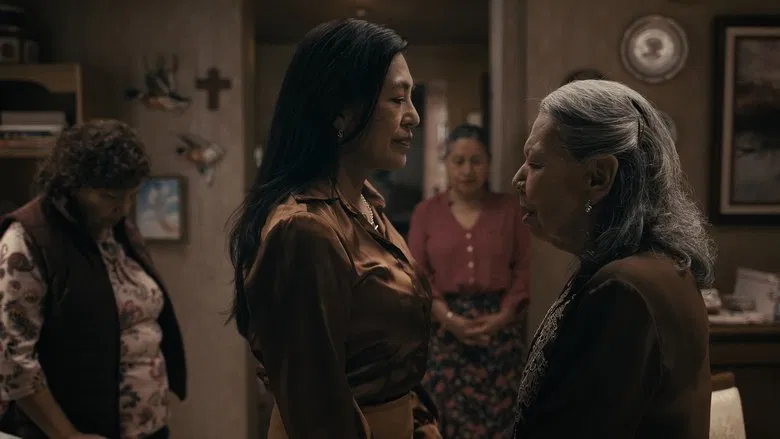
The film’s emotional core lies in its refusal to pathologize these women. In mainstream cinema, a woman on the verge of a breakdown is often a problem to be solved or a spectacle to be pitied. García, however, treats the breakdown as an act of rebellion. The screenplay is dense with the unspoken—the swallowed retort, the repressed scream—making the moments when the dam finally breaks feel earned and devastating. One particularly haunting sequence involves a simple car ride where the silence between a mother and daughter weighs more than any screamed argument could. It is a masterclass in tension, proving that the most violent conflicts often happen without a single blow being struck.
Ultimately, *The Follies* is a demanding watch. It lacks the easy catharsis of a traditional drama, opting instead for an ambiguous, lingering discomfort. It asks us to consider the cost of "keeping it together" in a society that prefers its women quiet and compliant. By the time the rain clears, nothing is neatly resolved, but the landscape has undeniably changed. García has delivered not just a portrait of six women, but a damning critique of the structures that try to contain them. It is a film that whispers a terrifying truth: we are all one bad day away from being the "crazy" woman in the window.