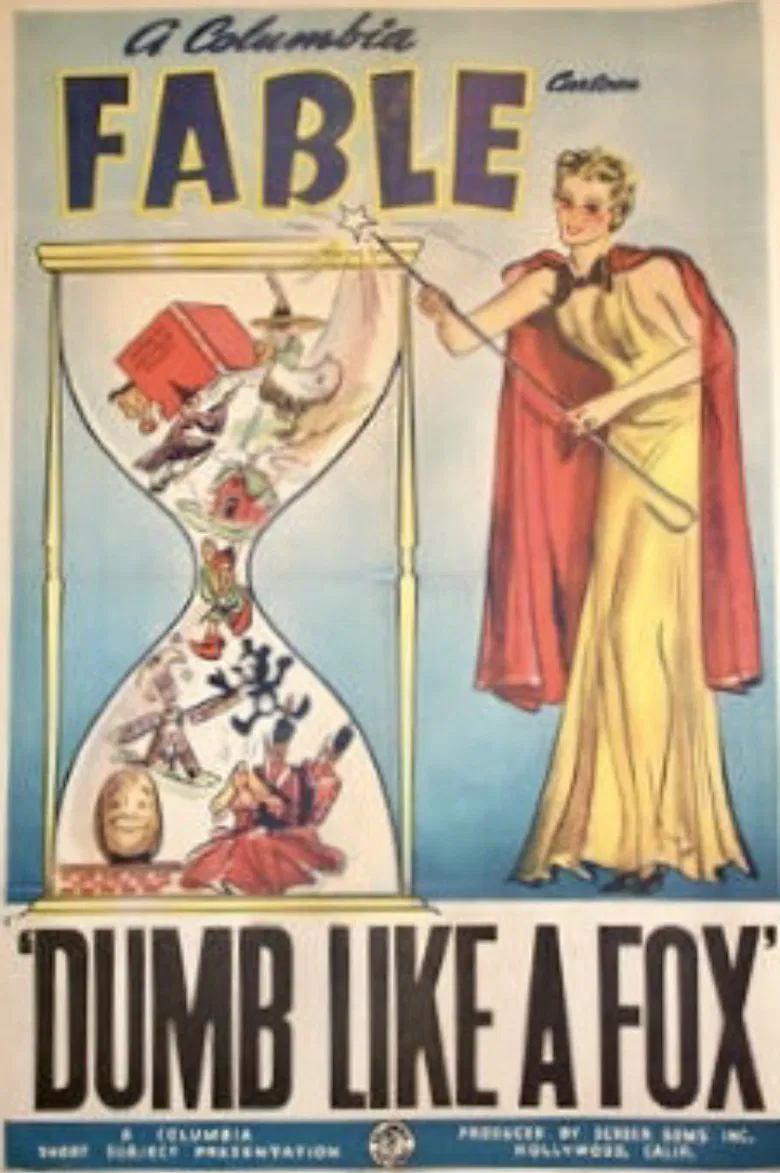
Dumb Like a Fox
1941
6m
Animation
Overview
A conceited fox sends an irascible little fox hound, who has never seen a fox before, after a beaver.
Reviews
✦ AI-generated review
The Myth of the Meritocracy
There is a peculiar dissonance at the heart of *Hero Without a Class: Who Even Needs Skills?!*, the latest offering from director Kaoru Yabana and Studio A-CAT. On its surface, the series presents itself as a scrappy underdog anthem—a rejection of divine determinism in favor of human grit. Yet, as the episodes unfold, this 2025 adaptation of Shichio Kuzu’s light novels reveals itself to be something far more cynical: a power fantasy that masquerades as a critique of privilege while quietly reinforcing it.
The premise is deceptively simple. In a world where every ten-year-old is bestowed a "Class" and "Skills" by a Goddess—literally gamifying social stratification—our protagonist Arel is left blank. The son of a legendary Sword Princess and an Archmage, Arel is the genetic aristocrat denied his inheritance.

Visually, the series struggles to elevate this narrative. Studio A-CAT, known for their often uneven integration of CGI, delivers a world that feels curiously flat. The environments—generic medieval villages and copy-paste forests—lack the texture of a lived-in reality. When Arel swings his sword, the animation often resorts to speed lines and impact frames rather than fluid choreography, a shortcut that robs the action of its physical weight. This visual economy mirrors the narrative's hollowness; just as the animation skips the "messy" frames of movement, the story skips the messy reality of struggle.
The "conversation" surrounding this film (and its source material) often centers on the "hard work beats talent" trope. But *Hero Without a Class* betrays this ethos almost immediately. Arel does not truly struggle; he simply succeeds through a different mechanic. His "classless" status becomes a loophole that allows him to learn *everything*, effectively making him not an underdog, but a glutton for power. The tension collapses when we realize we aren't watching a boy fight against a rigged system; we are watching a boy who has found a cheat code.
This is where the series unwittingly becomes a fascinating artifact of modern anxiety. Arel’s journey reflects a generation disillusioned by labels and "official" paths to success, yet still desperate for validation. The scene where he nonchalantly outperforms his "blessed" peers is treated as comedy, but it carries a frantic, almost desperate need to prove that the "system" is wrong. It is not enough for Arel to survive; he must humiliate the status quo. Kensho Ono’s vocal performance anchors this well, balancing a deadpan detachment with flashes of the arrogance that comes from knowing you are the smartest person in the room.
Ultimately, *Hero Without a Class* is a comfort object. It offers a soothing lie: that if the world refuses to give you a title, it is only because you are too big for one. It lacks the visual poetry to be a masterpiece and the narrative courage to be a true deconstruction. It stands as a "mid-tier" curiosity—a reflection of our desire to believe that "grit" is a magic spell that can solve any problem, provided you have the right genetics to back it up.
There is a peculiar dissonance at the heart of *Hero Without a Class: Who Even Needs Skills?!*, the latest offering from director Kaoru Yabana and Studio A-CAT. On its surface, the series presents itself as a scrappy underdog anthem—a rejection of divine determinism in favor of human grit. Yet, as the episodes unfold, this 2025 adaptation of Shichio Kuzu’s light novels reveals itself to be something far more cynical: a power fantasy that masquerades as a critique of privilege while quietly reinforcing it.
The premise is deceptively simple. In a world where every ten-year-old is bestowed a "Class" and "Skills" by a Goddess—literally gamifying social stratification—our protagonist Arel is left blank. The son of a legendary Sword Princess and an Archmage, Arel is the genetic aristocrat denied his inheritance.
Visually, the series struggles to elevate this narrative. Studio A-CAT, known for their often uneven integration of CGI, delivers a world that feels curiously flat. The environments—generic medieval villages and copy-paste forests—lack the texture of a lived-in reality. When Arel swings his sword, the animation often resorts to speed lines and impact frames rather than fluid choreography, a shortcut that robs the action of its physical weight. This visual economy mirrors the narrative's hollowness; just as the animation skips the "messy" frames of movement, the story skips the messy reality of struggle.
The "conversation" surrounding this film (and its source material) often centers on the "hard work beats talent" trope. But *Hero Without a Class* betrays this ethos almost immediately. Arel does not truly struggle; he simply succeeds through a different mechanic. His "classless" status becomes a loophole that allows him to learn *everything*, effectively making him not an underdog, but a glutton for power. The tension collapses when we realize we aren't watching a boy fight against a rigged system; we are watching a boy who has found a cheat code.
This is where the series unwittingly becomes a fascinating artifact of modern anxiety. Arel’s journey reflects a generation disillusioned by labels and "official" paths to success, yet still desperate for validation. The scene where he nonchalantly outperforms his "blessed" peers is treated as comedy, but it carries a frantic, almost desperate need to prove that the "system" is wrong. It is not enough for Arel to survive; he must humiliate the status quo. Kensho Ono’s vocal performance anchors this well, balancing a deadpan detachment with flashes of the arrogance that comes from knowing you are the smartest person in the room.
Ultimately, *Hero Without a Class* is a comfort object. It offers a soothing lie: that if the world refuses to give you a title, it is only because you are too big for one. It lacks the visual poetry to be a masterpiece and the narrative courage to be a true deconstruction. It stands as a "mid-tier" curiosity—a reflection of our desire to believe that "grit" is a magic spell that can solve any problem, provided you have the right genetics to back it up.