The End of the War, The Beginning of the WorldThere is a comfortable lie that romantic comedies tell us: the chase is the story, and the capture is the ending. For years, *Kaguya-sama: Love Is War* satirized this structure by turning the chase into a literal battlefield, a high-octane parody of *Death Note* psychological warfare where "I love you" was a admission of defeat. But with the arrival of the 2025 special, *Stairway to Adulthood*, the series attempts something far more dangerous than its previous comedic acrobatics. It attempts to show us what happens when the war ends, the armor comes off, and two brilliant, broken teenagers are forced to negotiate the terrifying peace treaty of actually being a couple.
The transition is jarring, perhaps intentionally so. Director Mamoru Hatakeyama has always excelled at visual maximalism—explosive title cards, rapid-fire editing, and hyperbolic visual metaphors. Here, the aesthetic volume is turned down. The frenetic energy of the Student Council room is replaced by the liminal, melancholic spaces of transition: the long shadows of a winter afternoon, the empty expanse of an airport runway, and the suffocating intimacy of a private room.

This visual quieting mirrors the narrative shift. The central tension is no longer "Will they?" but "How do we?" The "Stairway" in the title is not merely a metaphor for age, but a looming threat of physical and emotional intimacy that neither Kaguya Shinomiya nor Miyuki Shirogane is equipped to handle. The script condenses significant portions of the manga's final arcs, a choice that has sparked debate among purists. However, structurally, this compression forces the characters into a pressure cooker. We see the cracks in Kaguya's "Ice Queen" persona not as strategic feints, but as genuine tremors of anxiety about her future and her worthiness of love without the shield of competition.
The brilliance of this special lies in how it deconstructs the show’s own premise. In the past, Shirogane’s fatigue was a visual gag; here, it is treated with sobering realism—the exhaustion of a boy trying to outrun his own insecurities to reach Stanford. The looming separation caused by his overseas studies transforms the narrative from a battle of wits into a battle against time. The comedy is still present, particularly in the chaotic interventions of Chika Fujiwara, but the laughter feels different now. It is the nervous laughter of friends who know their time together is finite.
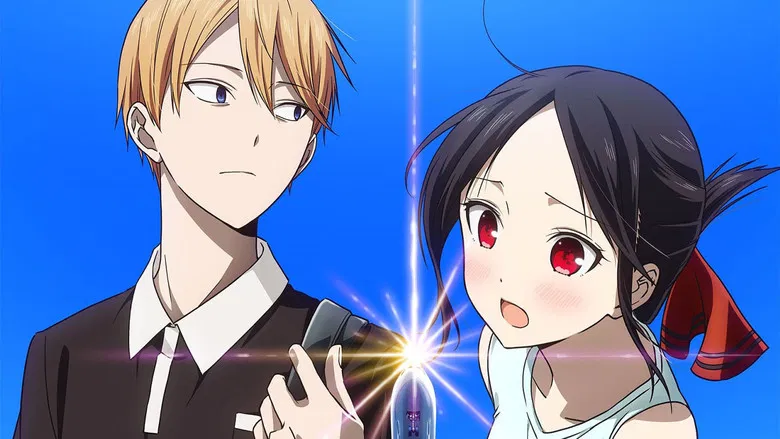
Ultimately, *Stairway to Adulthood* serves as a bridge—both for the characters and the franchise. It lacks the manic, dopamine-hit pacing of the "Ultra Romantic" arc, and at times, the weight of its own melodrama threatens to stall the momentum. Yet, it succeeds in a way few anime rom-coms dare: it respects its characters enough to let them grow up. It acknowledges that the "war" was never really about the other person; it was a civil war within themselves.
By the time the credits roll, the feeling is not one of triumph, but of a bittersweet resolve. The game is over, and the real work of living—and loving—has just begun. It is a quieter, more fragile entry in the saga, but perhaps the most human one yet.