The Architecture of GhostsThere is a fundamental misunderstanding at the heart of *The Girl in the Spider’s Web*, a slick, shivering thriller that attempts to transform the most prickly anti-heroine of 21st-century literature into a franchise-ready action star. Stieg Larsson’s original *Millennium* trilogy was a dense, uncomfortable examination of institutional misogyny and state corruption, anchored by Lisbeth Salander—a survivor whose hacking skills were a byproduct of her trauma, not a superpower. In this 2018 soft reboot, director Fede Álvarez (best known for the suffocating horror of *Don't Breathe*) smooths out those jagged edges, presenting a film that is visually elegant but spiritually hollow.
Álvarez is a filmmaker of immense technical precision, and he shoots Stockholm not as a living city, but as a necro-technological landscape of greys, icy blues, and deep blacks. The camera glides through modernist apartments and frozen archipelagos with a predatory smoothness. It is undeniably beautiful, yet it feels less like the grimy, tactile world of Scandinavian noir and more like the glass-and-steel universe of a Pierce Brosnan-era James Bond film. The grit has been power-washed away, replaced by a digital sheen that suggests nothing can truly stick to these characters—not snow, not blood, and certainly not the weight of their history.
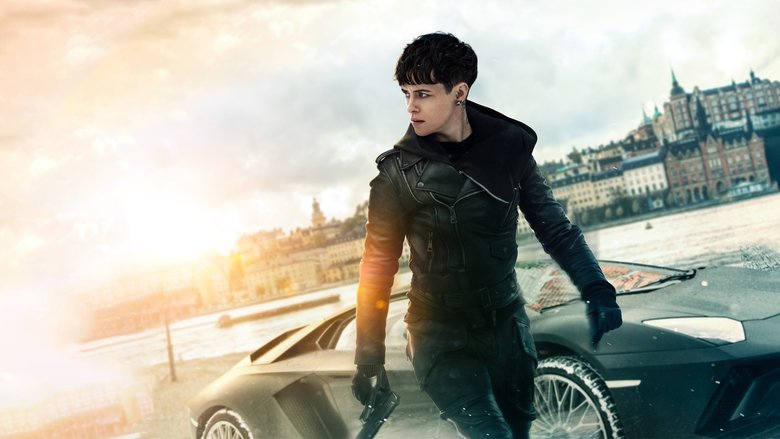
This tonal shift is most evident in how the film treats Lisbeth herself. Claire Foy, taking the mantle from Rooney Mara and Noomi Rapace, offers a performance of trembling intensity. Her Salander is older, wearier, and seemingly more fragile, yet her eyes retain that familiar, feral intelligence. However, the script betrays her nuance by thrusting her into scenarios that defy physics rather than intellect. We see her riding motorcycles across frozen lakes and surviving explosions in bathtubs—feats that belong to Ethan Hunt, not a socially maladjusted hacker.
The film’s most striking sequence—and the one that most clearly reveals Álvarez’s horror roots—involves Lisbeth being encased in a vacuum-sealed latex suit by her antagonists. It is a moment of terrifying, suffocating tactile reality in a movie otherwise obsessed with wireless wars. Yet, even this scene feels like an aesthetic exercise rather than a deepening of the character’s psychological torture. The villain, Lisbeth’s sister Camilla (Sylvia Hoeks), dressed in operatic red against the film’s monochrome palette, serves as a melodramatic reflection of Lisbeth’s past. But their conflict reduces the series' broad sociopolitical anger into a mere domestic dispute, a "sibling rivalry" writ large with nuclear codes.

Ultimately, *The Girl in the Spider’s Web* suffers from the "Batman-ization" of its protagonist. By elevating Lisbeth to a mythic avenging angel—literally framing her with wings in the opening shot—the film strips her of her most compelling attribute: her humanity. The original stories resonated because Lisbeth was a marginalized woman forcing the world to see her. Here, she is a superhero who essentially vanishes into the shadows of her own movie, overshadowed by a plot concerned with Firefall programs and global domination.
The film is a competent, often gripping machine, humming with the efficiency of a high-end server room. But in upgrading the operating system, the filmmakers accidentally deleted the soul. We are left with a ghost in the machine—a visually arresting echo of a character who once burned with a fire this cold, calculated movie cannot seem to rekindle.