The World of Tomorrow, TodayWhen Philip J. Fry falls into a cryogenic tube on New Year’s Eve 1999, he leaves behind a life defined by mediocrity and pizza delivery. When he wakes up a thousand years later, he hasn’t just entered a new millennium; he has stepped into one of the most resilient, intelligent, and deceptively profound animated series ever produced. *Futurama*, created by Matt Groening and David X. Cohen, is often reductively labeled as "The Simpsons in space." However, to view it merely as a sci-fi spin-off is to miss its distinct existential frequency. While its predecessor satirizes the American nuclear family, *Futurama* satirizes the human condition itself, asking what it means to find purpose in a universe that is vast, chaotic, and frequently hilarious.

Visually, the series is a triumph of "retro-futurism." The aesthetic of New New York is not a sleek, Apple-store vision of tomorrow, but a cluttered, neon-soaked homage to the sci-fi pulp magazines of the 1950s and the 1939 World’s Fair (from which the show borrows its name). The background art is meticulous, blending 3D computer-generated spaceships with traditional 2D character animation in a way that felt revolutionary in 1999 and remains stylish today. The show’s design language—curved fins, bubble helmets, and tube transport systems—creates a setting that feels nostalgic for a future that never happened. It suggests that no matter how advanced our technology becomes, humanity (and alien-ity) will still be messy, bureaucratic, and driven by base impulses.
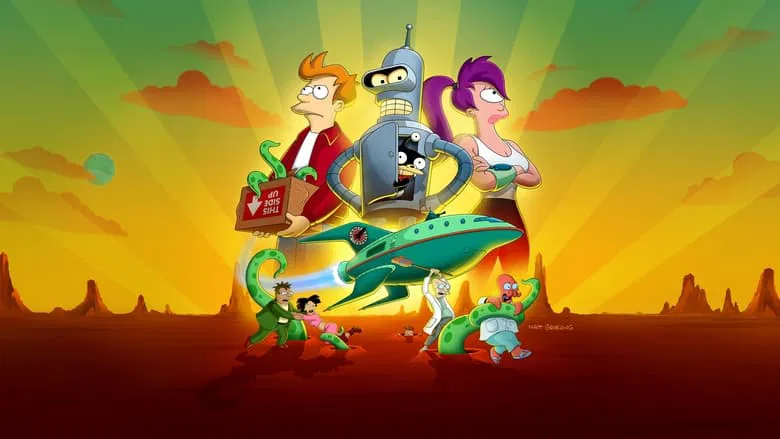
The true genius of *Futurama*, however, lies in its emotional ambush. The show lulls you into a false sense of security with slapstick involving Dr. Zoidberg’s poverty or Bender’s kleptomania, only to deliver a narrative payload of devastating poignancy. It utilizes the sci-fi genre not just for gags about time travel paradoxes, but to explore loss, memory, and destiny in ways live-action sitcoms rarely dare.
Take, for instance, the widely discussed episode "Jurassic Bark." On the surface, it is a quest to clone a fossilized dog. Beneath that, it is a meditation on loyalty and the pain of moving on. The final montage of that episode doesn't just tug at heartstrings; it severs them. Similarly, "The Luck of the Fryrish" recontextualizes sibling rivalry into a story of posthumous love and legacy. These moments work because the characters, despite being a one-eyed mutant, a bending robot, and a crustacean doctor, possess deeply recognizable internal lives. Fry’s journey is not just about adapting to the 31st century; it is about finding a "found family" among fellow outcasts who are all, in some way, broken.

Ultimately, *Futurama* endures because it balances its cynical worldview with a humanist heart. It mocks the idiocy of corporations, the incompetence of governments, and the vanity of mankind, yet it never succumbs to nihilism. In the end, the Planet Express crew may be delivering packages to dangerous planets for minimum wage, but they are also delivering a message to the audience: the future may be terrifying and weird, but as long as you have your crew, it’s worth the trip. It is a masterpiece of animation that proves you can feature a heavy-drinking robot and still be the most human show on television.