✦ AI-generated review
The Anomaly of Love
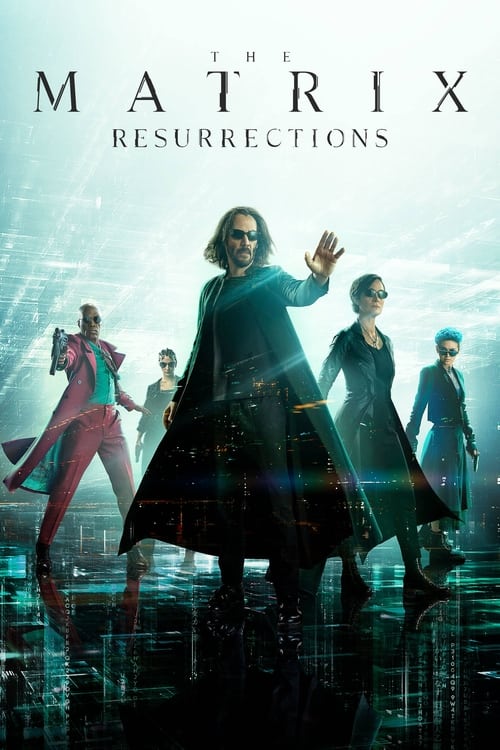
To revisit the *Matrix* is to revisit the bedrock of modern pop mythology. The original 1999 film was a sleek, chrome-plated treatise on control, blending cyberpunk philosophy with a hyper-stylized aesthetic that redefined action cinema. *The Matrix Resurrections* (2021), directed solo by Lana Wachowski, is an entirely different beast. It is a film that seems actively hostile to the very idea of its own existence, yet it manages to bloom into a profoundly vulnerable meditation on grief, aging, and the reclaiming of art from the jaws of commerce.
From its opening moments, *Resurrections* operates as a meta-textual hall of mirrors. We find Thomas Anderson (Keanu Reeves) not as a hacker, but as a legendary game designer who created a trilogy of games called *The Matrix*. He is trapped in a recursive loop of corporate brainstorming sessions where marketing executives—in a scene so on-the-nose it feels like a primal scream—debate what made the "brand" successful ("Bullet time! Guns! Mind-blowing philosophy!"). Here, Wachowski is not just breaking the fourth wall; she is dismantling the theater. She acknowledges that Warner Bros. would have churned out a sequel with or without her, and so she returns not to extend the "franchise," but to set it on fire.
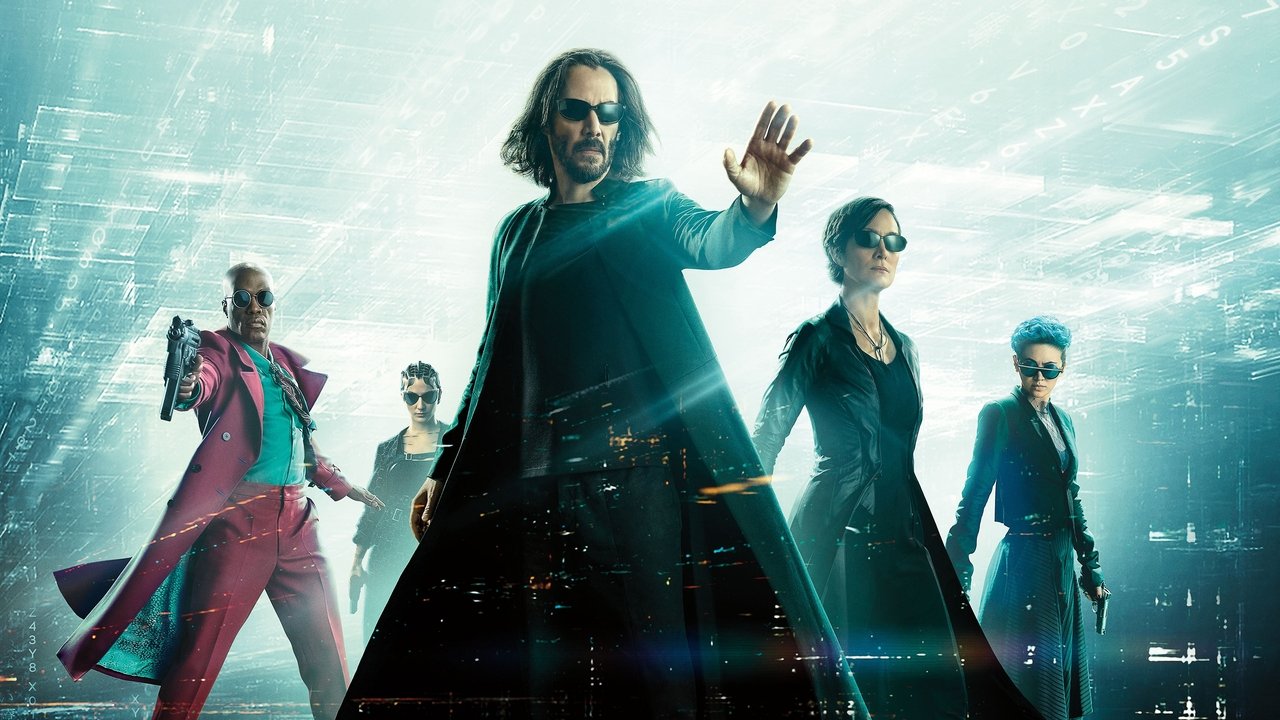
Visually, the film rejects the cold, calculated perfection of its predecessors. The sickly green tint and the mathematical precision of Yuen Woo-ping’s fight choreography are gone. In their place, cinematographer John Toll bathes the frame in the golden, chaotic warmth of natural sunlight. The action sequences are messier, less balletic, and more desperate. This aesthetic shift is jarring for purists, but it serves the narrative’s emotional logic: this is not a story about "cool" super-soldiers fighting a war; it is a story about two older souls trying to find each other in a world of noise. The gloss of 1999 has been replaced by the tactile fuzziness of memory.
At the heart of this digital storm lies the relationship between Neo and Trinity (Carrie-Anne Moss). While previous films treated their romance as a plot device to fulfill a prophecy, *Resurrections* posits that their connection *is* the prophecy. The chemistry between Reeves and Moss has deepened into something weathered and profound. Reeves plays Neo not as the stoic Superman, but as a man exhausted by his own legacy, radiating a palpable sadness. Moss, meanwhile, is the film’s gravitational center; her awakening is the narrative’s true climax. When they finally clasp hands, the film suggests that the "One" was never a messianic individual, but a binary star system—a dyad whose combined force is the only thing capable of rewriting reality.
The film is far from perfect. It collapses occasionally under the weight of its own exposition, and the absence of Hugo Weaving’s Agent Smith leaves a void that the script struggles to fill with new iterations. Yet, to judge *Resurrections* against the rubric of a standard summer blockbuster is to miss the point. It is a piece of subversive art therapy. Lana Wachowski has taken a property demanding mechanical reproduction and infused it with the messy, inconvenient pulse of human love. It is a glitch in the algorithm, refusing to be just another product, insisting instead on being a heartbeat.