The Opera of Falling GodsTo categorize Zack Snyder’s *Batman v Superman: Dawn of Justice* (2016) merely as a "superhero movie" is to misunderstand its fundamental ambition. It is, rather, a Wagnerian opera performed in spandex, a dense, brooding meditation on the geopolitics of divinity. Released as a sequel to *Man of Steel*, it bypasses the colorful escapism of its genre contemporaries to wade into the murky waters of post-9/11 trauma. If the modern blockbuster is often a theme park ride, Snyder has constructed a cathedral—vast, imposing, and echoing with the screams of the fallen.
The film does not open with triumph, but with terror. We witness the climactic battle of the previous film from the ground level, through the eyes of a graying, embittered Bruce Wayne (Ben Affleck). He runs into the choking dust clouds of a collapsing Metropolis, an evocative visual directly lifting from the imagery of September 11th. This establishes the film's central thesis: In a world of gods, human powerlessness inevitably curdlings into radicalized rage. Affleck’s Batman is not a hero here; he is a villain born of xenophobia, a man who has replaced his moral code with a preemptive doctrine of absolute destruction.

Visually, the film is a rejection of the flat, television-style lighting that plagues modern cinema. Cinematographer Larry Fong and Snyder paint in heavy chiaroscuro, turning every frame into a baroque tableau. The imagery is heavy, almost suffocating. Note the sequence where Superman (Henry Cavill) hovers above flood victims, backlit by the sun—a reluctant messiah trapped in a painting he never asked to inhabit. The film is less interested in fluid action than in iconographic weight; it wants to freeze these characters in moments of mythic agony.
The narrative structure, particularly in the superior "Ultimate Edition," operates like a political thriller. The script weaves a complex web involving Lex Luthor (Jesse Eisenberg), who is re-imagined here not as a calm industrialist but as a twitchy Silicon Valley millennial atheist. Luthor’s hatred of Superman is theological; he cannot reconcile the idea of an all-powerful God with an all-good God. Eisenberg’s performance is frantic, but it serves the film’s deconstruction of power. He weaponizes the public's fear, turning the "Man of Tomorrow" into a figure of controversial debate, best exemplified by a montage of talking heads asking, "Must there be a Superman?"
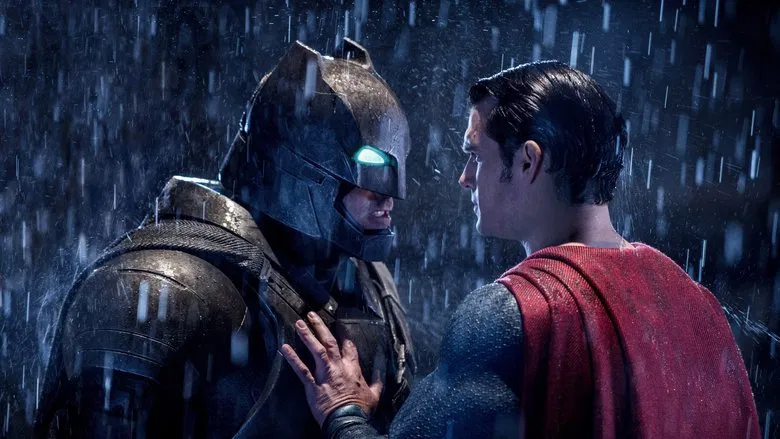
Much has been made of the infamous "Martha" moment, often mocked for its execution. However, viewed through the lens of trauma, the scene reveals the film's emotional core. Batman, who has dehumanized Superman into an alien "it," is forced to pause when he hears the name of his own dying mother. It is a clumsy but earnest attempt to resolve the film's central conflict: empathy. The realization that the alien has a mother—that he is human in the ways that matter—shatters Bruce Wayne’s nihilistic resolve. It is the moment the monster becomes a man again.
Ultimately, *Batman v Superman* is a flawed masterpiece of mood and metaphor. It collapses under its own gravity at times, burdened by the need to launch a cinematic universe. Yet, it possesses a distinct, authorial voice that is vanishingly rare in the intellectual property era. It dares to ask if we, as a society, deserve heroes at all, or if we would simply drag them down into the mud with us. In 2016, it was rejected for being too dour; years later, its cynicism feels startlingly like prophecy.