✦ AI-generated review
The Toxicology of Power
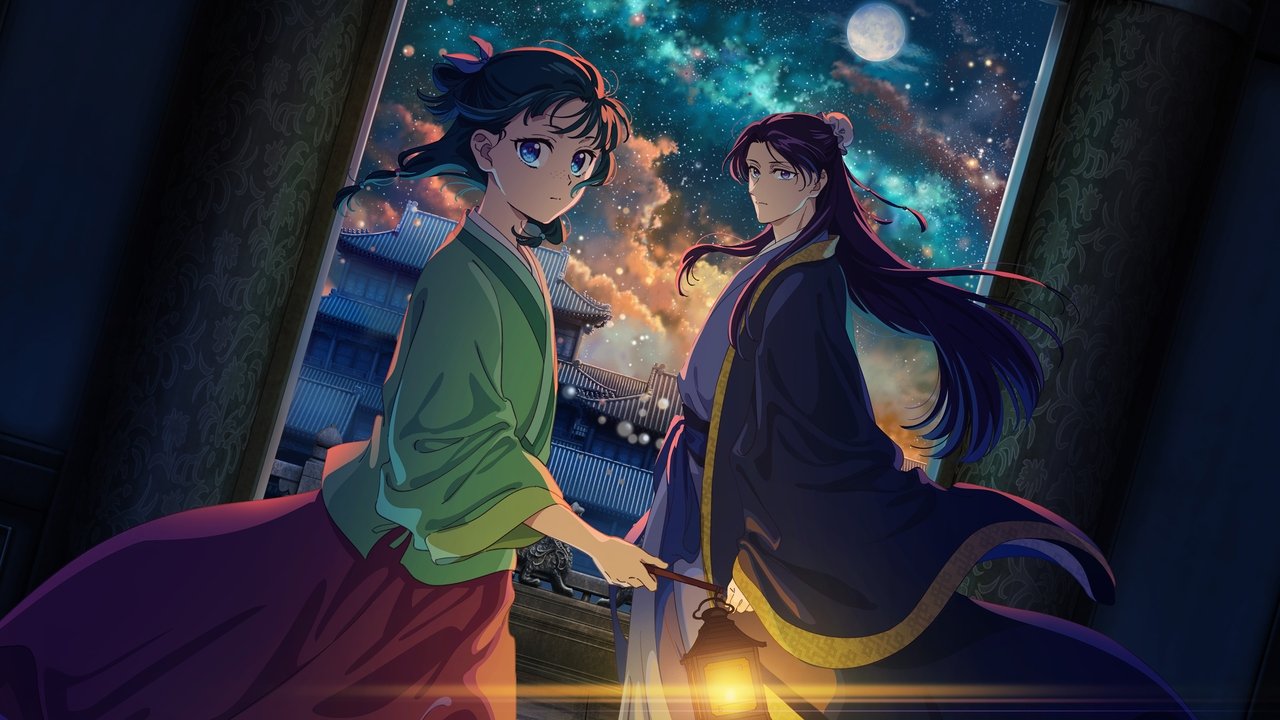
The "Rear Palace"—that hermetically sealed aviary of concubines and eunuchs common to East Asian period dramas—is usually framed as a theater of weeping and seduction. In *The Apothecary Diaries* (2023), however, director Norihiro Naganuma reimagines this setting not as a soap opera, but as a crime scene. Here, the painted smiles of imperial consorts are merely variables in a biological equation, and the series’ protagonist, Maomao, is the brilliant, disaffected scientist solving for X.
Adapted from Natsu Hyūga’s light novels, the anime distinguishes itself immediately by refusing to romanticize its own premise. While the visuals, produced by TOHO Animation and OLM, are undeniably lush—awash in the vermilion lacquers and silk brocades of a fictionalized Tang Dynasty China—they serve a deceptive function. The camera lingers on beauty only to dismantle it. We see a perfectly manicured garden, but Maomao sees the toxic oleander lurking in the shrubbery. We see the terrifyingly beautiful "eunuch" Jinshi, but Maomao sees a troublesome peacock whose plumage is a distraction from the work at hand. The visual language constantly toggles between the "sparkling" filter of the court’s self-perception and the drab, greenish tint of Maomao’s cynical reality.
At the center of this dissonance is Maomao herself, a character who defies the gravity of the "harem" genre. Voiced with a delicious, low-register ennui by Aoi Yuuki, Maomao is neither a damsel awaiting rescue nor a schemer seeking status. She is a pragmatist who views emotions as chemical reactions and poisons as old friends. The series’ most defining sequence occurs early on during a garden party, where Maomao acts as a food taster. While other servants tremble at the thought of poison, Maomao consumes a tainted soup with the ecstatic palate of a sommelier, her face flushing not with fear, but with the thrill of identifying the toxin. It is a moment of grotesque comedy that perfectly encapsulates the show’s ethos: in a world built on lies, the only honest thing is the chemistry that can kill you.
The narrative structure operates as a procedural, echoing the deductive rhythms of *House, M.D.* or *Sherlock*, yet it is confined to a domestic sphere where men are largely absent or impotent. This restriction forces the tension inward. The stakes are rarely about war or conquest, but about the inheritance of a hairpin, an allergy to face powder, or the tragic ignorance of a mother. By treating these "feminine" domestic tragedies with the rigor of forensic science, Naganuma elevates them. The script treats the ignorance of the era not with mockery, but with the frustration of a doctor watching a patient bleed out from a preventable wound.
If the series stumbles, it is perhaps in its reliance on the "chibi" (super-deformed) animation style to diffuse tension. While these moments underscore Maomao’s internal mockery of court etiquette, they occasionally undercut the genuine peril of her situation. Yet, this is a minor quibble in a show that manages to be so intellectually sturdy.
Ultimately, *The Apothecary Diaries* succeeds because it understands that knowledge is the only true currency for the powerless. Maomao does not survive the palace because she is beautiful or charming; she survives because she understands the properties of lead and mercury. In a genre often obsessed with who holds the Emperor’s favor, this series asks a far more interesting question: who holds the antidote?