The Architecture of MelancholyRemaking a masterpiece is often a fool’s errand, particularly when the source material is as culturally enshrined as the 2018 Korean drama *My Mister*. To touch such a text is to invite immediate, often unkind, comparison. Yet, *Loving Strangers* (2026), directed by Han Tian, manages to step out from the formidable shadow of its predecessor not by imitating its beats, but by transposing its soul into a distinctly Chinese frequency. Set against the vertical, fog-drenched labyrinth of Chongqing, the series transforms a story of urban alienation into a visual poem about the weight of silence in a noise-filled world.
The narrative architecture rests on two crumbling pillars: Jiang Jiaqi (Mark Chao), a structural engineer whose stoicism masks a life quietly imploding under workplace politics and marital betrayal, and Liang Zhi'an (Zhang Zifeng), a twenty-year-old drifter hardened by debt and the crushing responsibility of a paralyzed grandmother.
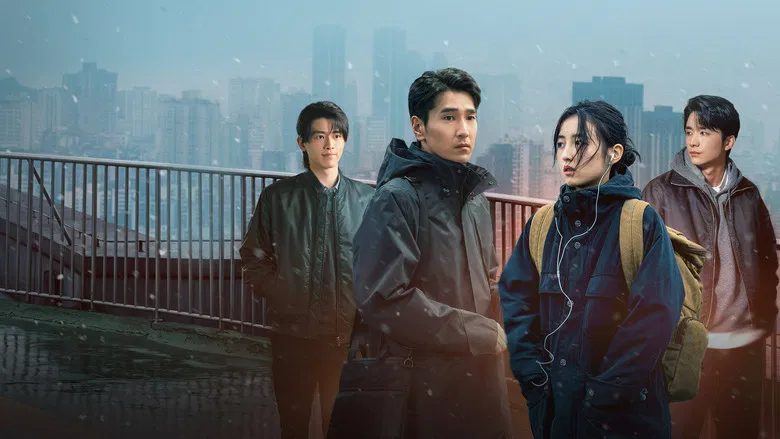
Visually, Han Tian treats the city of Chongqing not merely as a backdrop, but as an externalization of the characters' internal mazes. The camera lingers on the tangle of monorails disappearing into residential blocks and the endless, damp staircases that seem to lead nowhere. Unlike the crisp, cold winter of the Seoul-based original, this world is humid, heavy, and suffocating. The director favors a stripped-down aesthetic, often framing Jiang and Liang through windows, partitions, and glass—emphasizing that while they are physically close to others, they remain hermetically sealed in their own private suffering. The sound design is equally crucial; the show dares to let scenes breathe with uncomfortable silences, where the hum of a copier or the clatter of a street-side eatery says more about loneliness than any monologue could.
At the heart of *Loving Strangers* is a profound performance duet that eschews melodrama for micro-expression. Mark Chao, often known for more romanticized roles, here dissolves into the slump-shouldered resignation of middle age. He plays Jiang not as a hero, but as a man trying to maintain structural integrity while his foundation rots.
However, it is Zhang Zifeng who provides the show’s jagged edge. As Liang Zhi'an, she is a feral creature of survival—eyes darting, body tense, eating leftover food with a desperate speed that breaks the heart. The chemistry between them is difficult to categorize, defying the standard romantic tropes of "drama." It is not a romance in the conventional sense, but a recognition of shared scars. When Liang listens to Jiang’s life through wiretapped audio—originally intended to destroy him—the act of listening transforms into an act of witnessing. In a culture obsessed with success and "face," their bond is a subversive admission that it is okay to be broken.
The series does falter occasionally under its own atmospheric weight. The pacing is deliberately glacial, a "slow burn" that demands patience from a modern audience conditioned for dopamine hits. Furthermore, some of the workplace machinations feel slightly archaic, a relic of the script's older DNA that doesn't quite mesh with the hyper-modern tech setting of 2026.
Yet, *Loving Strangers* succeeds because it understands that the most heroic act in modern life is often just enduring the day. It validates the quiet dignity of the "ahjeosshi" (or in this case, the *dashu*) and the lost girl, suggesting that salvation doesn't come from grand gestures, but from the simple, terrifying act of letting someone else know you are in pain. In an era of curated happiness, this series offers a beautiful, somber reminder: we heal not by hiding our darkness, but by sharing it.