✦ AI-generated review
The Thread That Binds the Sky
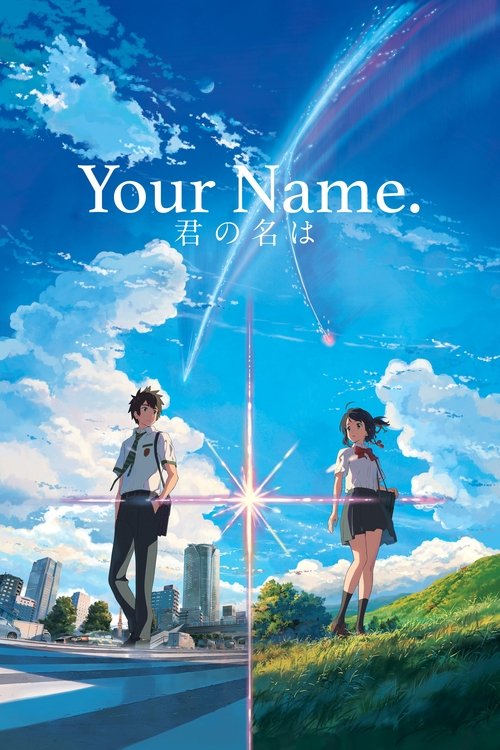
For years, Makoto Shinkai was cinema’s poet of unrequited distance. His earlier works, particularly *5 Centimeters Per Second*, were beautiful but bruising meditations on the way time and space erode human connection. They were films about drifting apart. With *Your Name* (2016), Shinkai inverted his own thesis. He stopped looking at the gaps between us and started looking at the knots. Emerging from the national trauma of the 2011 Tōhoku earthquake, this is not merely a body-swap romance; it is a desperate, dazzling prayer for a second chance—a rewriting of apocalypse through the sheer force of memory.
Shinkai’s visual language has always been defined by a suffocatingly beautiful hyper-realism. He paints Tokyo not as a grey metropolis, but as a shimmering organism of glass and light. Every lens flare, every sliding train door, every smartphone screen is rendered with a reverence usually reserved for religious iconography. In *Your Name*, this aesthetic serves a dual purpose. It grounds the fantastical premise—a boy in Tokyo (Taki) and a girl in the rural town of Itomori (Mitsuha) switching bodies—in a tactile reality. We feel the sliding of the shoji doors and the hum of the Yamanote line. This grounding makes the film’s mid-point pivot from teenage comedy to disaster drama feel not just shocking, but physically heavy. When the sky falls, it crushes a world we have learned to touch.
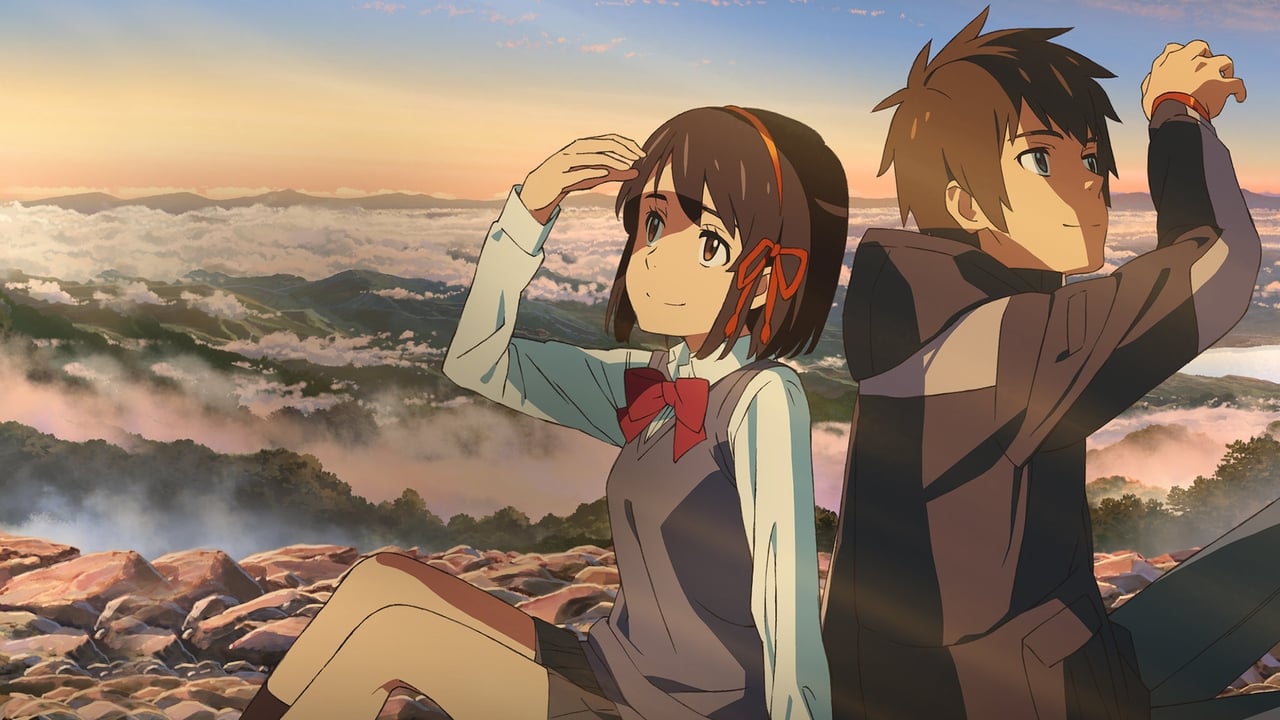
The film’s central metaphor is *Musubi*—the concept of knotting or binding. Explained by Mitsuha’s grandmother, it frames time not as a linear arrow, but as a braided cord that twists, tangles, and sometimes unravels. This creates a narrative structure that is complex but never confusing. The film demands we accept that love is a form of nonlinear physics. When Taki and Mitsuha finally meet during "Kataware-doki" (twilight), the film abandons logic for emotional truth. They are separated by three years and a catastrophe, yet they stand together in the blue-gold light. It is a visual rejection of the finality of death.
What elevates *Your Name* above its genre trappings is its profound empathy. The body-swapping device, often played for cheap laughs in lesser films, here becomes a radical act of understanding. Taki and Mitsuha do not just observe each other; they literally walk in one another’s shoes, consuming each other's food and living each other's struggles. This intimacy becomes the fuel for the film’s climax. They fight to save Itomori not just because they are in love, but because they have lived that life. They refuse to let a town become a statistic.
In the end, *Your Name* is a correction. It is Shinkai looking back at the cynicism of his earlier career and choosing hope. The comet that arcs over the film is a harbinger of doom, yes, but also of connection. In a world defined by sudden loss—whether by natural disaster or the slow drift of time—Shinkai argues that the refusal to forget is a superpower. We may not be able to stop the meteor, the film suggests, but if we hold onto the thread tightly enough, we might just wake up in a world where we didn't have to say goodbye.