The combustible Power of MythHistory is usually a prison. In the realm of factual record, the tragedies of the past are immutable; the monsters win until they don't, and the victims remain buried under the weight of statistics. But Quentin Tarantino has never been one to let the truth get in the way of a good story. In *Inglourious Basterds* (2009), he doesn't just dramatize World War II; he weaponizes cinema itself to rewrite it. This is not a war movie in the traditional sense—it is a spaghetti western set in the Third Reich, a fairy tale beginning with "Once upon a time..." where the wolves are dressed in SS uniforms and the woods are made of celluloid.
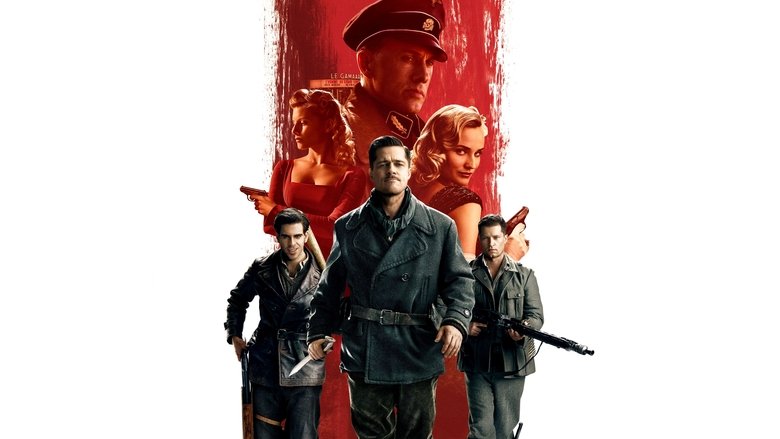
The film’s visual language is a study in agonizing, delicious tension. Tarantino abandons the shaky-cam chaos typical of modern combat films in favor of the patient, predatory gaze of Sergio Leone. Nowhere is this more evident than in the opening chapter. The farmhouse interrogation is a masterclass in verbal violence, where Colonel Hans Landa (Christoph Waltz) uses politeness as a bludgeon. The camera lingers on a glass of milk or a smoking pipe, turning mundane objects into instruments of terror. Tarantino understands that the threat of violence is often more cinematic than the act itself. When the violence does erupt, it is sudden and grotesque, but the true horror lies in the quiet moments before—the silence that stretches until it snaps.
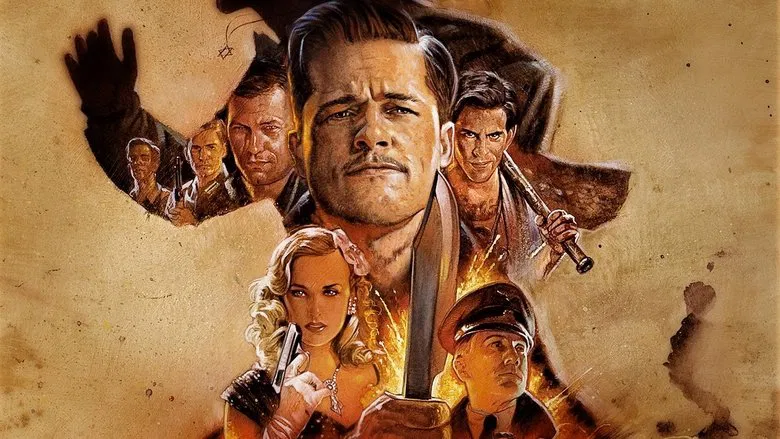
While the titular Basterds—Brad Pitt’s scalp-hunting squad—provide the film’s pulp marketing hook, the emotional heart beats within Shosanna Dreyfus (Mélanie Laurent). She is the ghost in the machine, the survivor who transforms her trauma into a literal conflagration. Unlike the Basterds, who operate with the blunt force of American exceptionalism, Shosanna’s weapon is cinema itself. She understands that the Third Reich was largely a product of propaganda, a regime built on image and spectacle. Therefore, her plan to lock the Nazi high command in her theater and burn them alive using highly flammable nitrate film is not just poetic justice; it is a profound statement on the power of art. She fights fire with film, turning the "silver screen" into a pyre.

Ultimately, *Inglourious Basterds* is a daring act of cinematic exorcism. By allowing a Jewish woman to incinerate the architects of the Holocaust while her laughing face is projected onto the smoke, Tarantino offers a catharsis that history denied us. It is a sequence of terrifying beauty that implicates the audience: we cheer for the brutality because, in the dark of the theater, we crave the moral simplicity of vengeance. The film ends with Aldo Raine carving his mark into Landa’s forehead and declaring it his "masterpiece." One gets the sense that Tarantino is speaking through him, acknowledging that while he cannot change the past, he can, for two and a half hours, make us believe in a world where the righteous strike the final match.